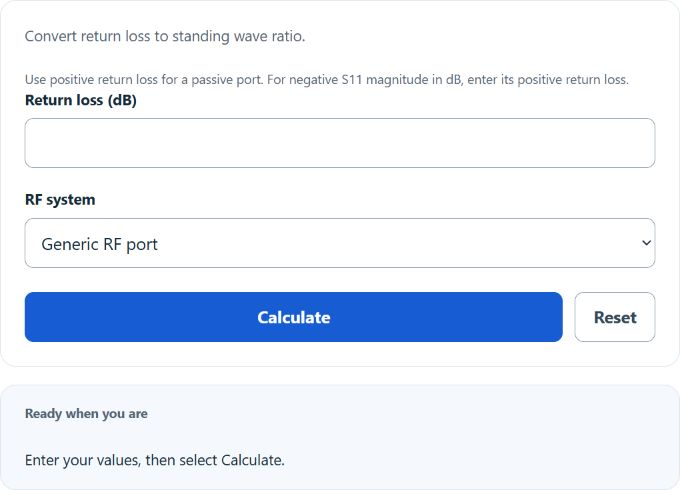
Calculate SWR, reflection coefficient magnitude and reflected power from nonnegative return loss in dB for a passive RF port. A negative S11 magnitude in dB corresponds to positive return loss.
Quick Overview: dB to SWR
Return loss in dB and SWR are two common ways to describe how well an RF device is matched.
- 6 dB → SWR ≈ 3.01 : 1
- 10 dB → SWR ≈ 1.92 : 1
- 14 dB → SWR ≈ 1.50 : 1
- 20 dB → SWR ≈ 1.22 : 1
The conversion is based on first calculating the reflection coefficient magnitude using |Γ| = 10(−RL/20) and then computing SWR = (1 + |Γ|) / (1 − |Γ|).
- dB To Pressure Calculator
- K to Ohms Conversion Calculator
- Bits Per Second To Mbps Calculator
- Hz to RPM Calculator
- All Unit Converters
dB to SWR Formula
The following formulas are used to convert return loss in decibels to the corresponding standing wave ratio.
Variables:
- RL is the return loss in decibels
- |Γ| is the reflection coefficient magnitude
- SWR is the standing wave ratio
To calculate SWR, first determine the reflection coefficient magnitude from return loss, then substitute it into the SWR formula. At 0 dB return loss, all incident power is reflected and SWR is infinite. Negative return loss is outside this passive-port model.
What is dB to SWR Conversion?
dB to SWR conversion is the process of translating a return loss measurement into a standing wave ratio. Return loss is a logarithmic way of expressing how much signal is reflected back from a mismatch, while SWR expresses the same idea as a ratio relative to a perfect match of 1:1. Higher return loss values correspond to lower reflection and therefore lower SWR values.
This conversion is widely used in RF engineering for antennas, transmission lines, amplifiers, and filters. It allows engineers and hobbyists to compare test equipment readings, antenna analyzer values, and datasheet specifications more easily.
How to Convert dB to SWR?
The following steps outline how to convert return loss in dB to SWR.
- First, determine the return loss value in decibels (RL).
- Next, calculate the reflection coefficient magnitude using |Γ| = 10(−RL/20).
- Then, calculate the standing wave ratio using SWR = (1 + |Γ|) / (1 − |Γ|).
- Finally, compare the result with the calculator above to verify the answer.
Example Problem:
Use the following variables as an example problem to test your knowledge.
Return Loss (RL) = 20 dB
Reflection Coefficient Magnitude (|Γ|) = 10(−20/20) = 0.1
SWR = (1 + 0.1) / (1 − 0.1) = 1.22 : 1
dB to SWR Conversion Table
The table below shows example conversions from return loss values in dB to reflection coefficient magnitude and SWR.
| Return Loss (dB) | |Γ| (approx.) | SWR (approx.) |
|---|---|---|
| 3 dB | 0.7079 | 5.85 : 1 |
| 6 dB | 0.5012 | 3.01 : 1 |
| 10 dB | 0.3162 | 1.92 : 1 |
| 14 dB | 0.1995 | 1.50 : 1 |
| 20 dB | 0.1000 | 1.22 : 1 |
| 26 dB | 0.0501 | 1.11 : 1 |
| 30 dB | 0.0316 | 1.07 : 1 |
| 40 dB | 0.0100 | 1.02 : 1 |
For example, a return loss of 20 dB gives a reflection coefficient magnitude of 0.1 and an SWR of about 1.22:1. A much lower return loss such as 6 dB indicates a poorer match, producing an SWR of about 3.01:1.