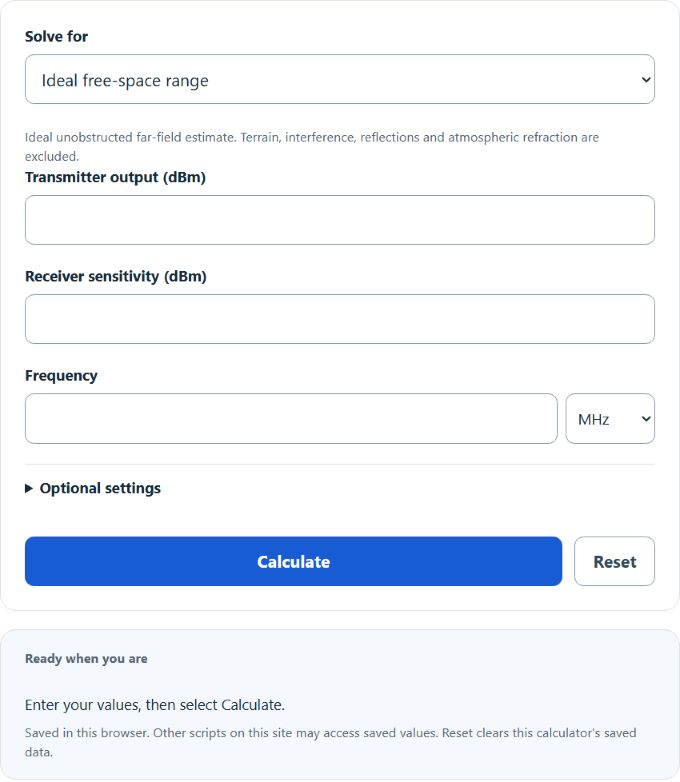
Estimate ideal RF range or reverse-size transmitter power and receiver sensitivity using frequency, antenna gains, losses, fade margin, and radio horizon.
- Electricity, Magnetism, & Electronics Unit Converters
- All Unit Converters
- Antenna dBi Range Calculator
dBm to Range Formula
The calculator estimates ideal far-field free-space range from frequency, transmit power, receiver sensitivity, antenna gains, losses and fade reserve. It does not model terrain, obstacles, interference or atmospheric refraction.
Variables:
- R is the ideal free-space range in kilometers before the selected output conversion
- Pt is the transmitter power in dBm
- Pr is the receiver sensitivity (minimum required received power) in dBm
- A is the allowable free-space path loss: Pt + transmit gain + receive gain − transmit loss − receive/other loss − Pr − fade reserve, all in dB or dBm as applicable
- fMHz is frequency in megahertz
- The constant uses the exact speed of light, 299,792,458 m/s. Enter both antenna heights to compare the separate geometric horizon, using Earth radius 6,371 km without refraction.
Calculate the path-loss allowance A, subtract 32.44778322 and 20 log10(f in MHz), divide by 20 and raise 10 to the result. A single dBm level cannot determine range.
| Meters (m) | Kilometers (km) | Miles (mi) |
|---|---|---|
| 10 | 0.010 | 0.006 |
| 20 | 0.020 | 0.012 |
| 30 | 0.030 | 0.019 |
| 50 | 0.050 | 0.031 |
| 75 | 0.075 | 0.047 |
| 100 | 0.100 | 0.062 |
| 150 | 0.150 | 0.093 |
| 200 | 0.200 | 0.124 |
| 250 | 0.250 | 0.155 |
| 300 | 0.300 | 0.186 |
| 400 | 0.400 | 0.249 |
| 500 | 0.500 | 0.311 |
| 750 | 0.750 | 0.466 |
| 1,000 | 1.000 | 0.621 |
| 1,500 | 1.500 | 0.932 |
| 2,000 | 2.000 | 1.243 |
| 3,000 | 3.000 | 1.864 |
| 5,000 | 5.000 | 3.107 |
| 8,000 | 8.000 | 4.971 |
| 10,000 | 10.000 | 6.214 |
| Conversion factors: 1 km = 1000 m, 1 mi = 1609.34 m. | ||
What is a dBm to Range Calculator?
This calculator applies a free-space link budget. It can solve for ideal range, required transmitter output or required receiver sensitivity. Actual usable range also depends on antenna far-field distance, clearance, terrain, interference and propagation conditions. Optional heights provide a separate geometric-horizon comparison.
How to Calculate Range?
The following steps outline how to calculate the range.
- First, determine the transmitter power (Pt).
- Next, determine the receiver sensitivity (Pr).
- Next, enter frequency and any antenna gains, transmit cable loss, receive/other loss and fade reserve.
- Optionally enter both antenna heights for a geometric-horizon comparison.
- Finally, select Calculate to apply the free-space formula above.
- After inserting the values and calculating the result, check your answer with the calculator above.
Example Problem :
Use the following variables as an example problem to test your knowledge.
Transmitter Power (Pt) = 20 dBm
Receiver Sensitivity (Pr) = -90 dBm
Frequency = 2,400 MHz; gains, cable losses and fade reserve = 0 dB
Allowable path loss A = 20 − (−90) = 110 dB
Solution: R = 10(110 − 32.44778322 − 20 log10(2400))/20 ≈ 3.143 km under ideal free-space conditions.