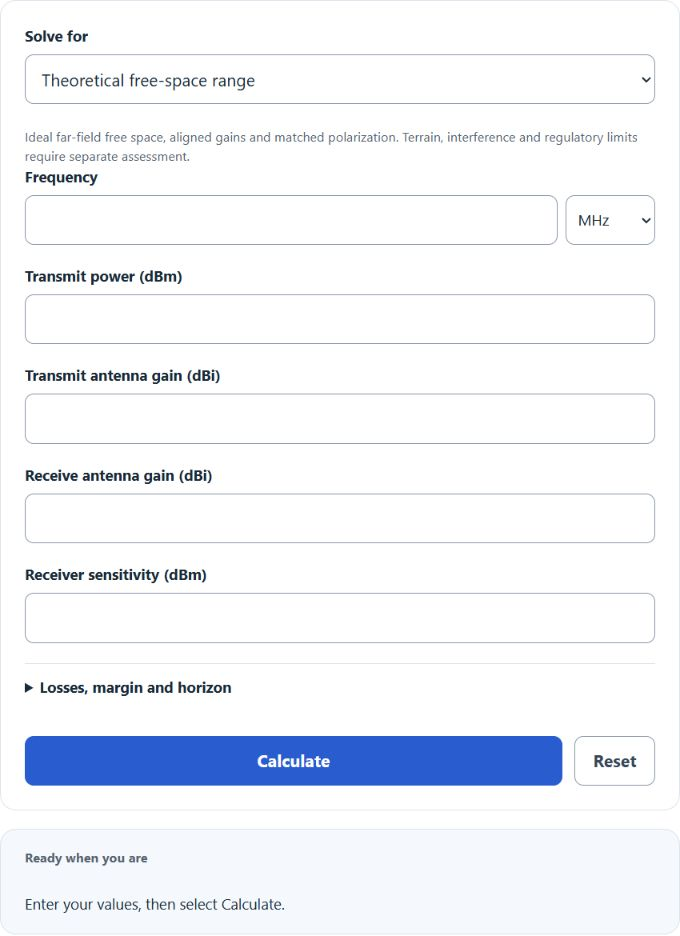
Estimate free-space radio range from power, frequency, dBi gains, receiver sensitivity, losses, and fade margin, or reverse-solve required transmit power with horizon context.
Related Calculators
- Polarization Calculator
- Amp Loss Over Distance Calculator
- Average Noise Level Calculator
- Spectral Density Calculator
- All Physics Calculators
Antenna dBi Range Formula
The antenna dBi range calculator uses the Friis free-space transmission equation. It assumes a clear line-of-sight path with no terrain, building, foliage, multipath, or Fresnel-zone blockage losses unless you enter them in the other losses field.
To solve for transmitter power:
To solve for total antenna gain:
To solve for range:
The calculator works in dB for the link budget. The equivalent linear-power and gain conversions are:
- lambda = wavelength in meters
- c = speed of light, 299,792,458 m/s
- f = frequency in Hz
- Pr = minimum received power, also called receiver sensitivity, in watts
- Pt = transmitter power in watts
- G = total antenna gain as a linear ratio, based on the combined transmit and receive antenna gain
- G_dBi = total antenna gain in dBi
- R = free-space range in meters
- L = other losses as a linear ratio
- Loss_dB = cable, mismatch, connector, polarization, or other added losses in dB
Choose Theoretical free-space range or Required transmit power. Enter transmit and receive antenna gains separately in dBi. Losses and fade margin are optional; blank means 0 dB. Both antenna heights may be entered for approximate geometric-horizon context, or both may be left blank.
Gain inputs use dBi. If your data uses dBd, convert it before entry using:
Common Antenna Gain and Unit Reference
| Item | Typical value | Use in the calculator |
|---|---|---|
| Isotropic reference | 0 dBi | Baseline gain reference |
| Half-wave dipole | 2.15 dBi, or 0 dBd | Enter 2.15 dBi for 0 dBd; there is no dBd selector |
| Small whip or PCB antenna | -3 to 3 dBi | Common for compact devices |
| Omnidirectional vertical antenna | 3 to 9 dBi | Common for base stations and access points |
| Panel or Yagi antenna | 8 to 18 dBi | Directional links with moderate gain |
| Dish antenna | 20 dBi and higher | Longer directional links |
| Quantity | Conversion | Note |
|---|---|---|
| dBm to watts | W = 10^((dBm - 30)/10) | 0 dBm = 1 mW |
| dBW to watts | W = 10^(dBW/10) | 0 dBW = 1 W |
| dBd to dBi | dBi = dBd + 2.15 | dBd is referenced to a half-wave dipole |
| Loss dB to linear loss | L = 10^(Loss_dB/10) | Higher loss reduces received power and range |
Example Calculations
Example 1: Calculate range
Suppose you enter these values:
- Frequency = 2.4 GHz
- Receiver sensitivity = -90 dBm
- Other losses = 2 dB
- Transmitter power = 30 dBm (1 W)
- Transmit gain = 3 dBi and receive gain = 3 dBi
- Choose Theoretical free-space range; enter 0 dB fade margin
The calculator converts -90 dBm to 1.0e-12 W, converts 6 dBi to a linear gain of about 3.981, and applies the Friis range formula. The result is about 15.8 km in ideal free space.
Example 2: Calculate required transmit power
Suppose you enter these values:
- Frequency = 915 MHz
- Receiver sensitivity = -100 dBm
- Other losses = 2 dB
- Transmit gain = 2 dBi and receive gain = 2 dBi
- Range = 30 km
- Choose Required transmit power; enter 0 dB fade margin
The required transmit power is about 19.2186 dBm (0.0835 W) in this free-space model. Real-world losses and an appropriate margin may increase the requirement.
FAQs
What does total antenna gain mean?
Total antenna gain is the combined gain of the transmit antenna and receive antenna in dB terms. For example, if the transmit antenna is 4 dBi and the receive antenna is 6 dBi, the combined gain is 10 dB. Enter 4 and 6 in the separate dBi gain fields; the link budget adds them.
Why is the calculated range different from real-world range?
The result is a free-space estimate. Real links can be shorter because of obstacles, ground reflections, Fresnel-zone blockage, polarization mismatch, antenna misalignment, cable loss, interference, noise, and regulatory power limits. Add known cable and mismatch losses in the other losses field, but treat the final number as an ideal line-of-sight estimate unless you have a full link budget.
Does higher frequency reduce range?
Yes, for the same transmitter power, antenna gain, receiver sensitivity, and losses, higher frequency gives a shorter wavelength. In the Friis equation, a shorter wavelength increases free-space path loss, which reduces the calculated range.