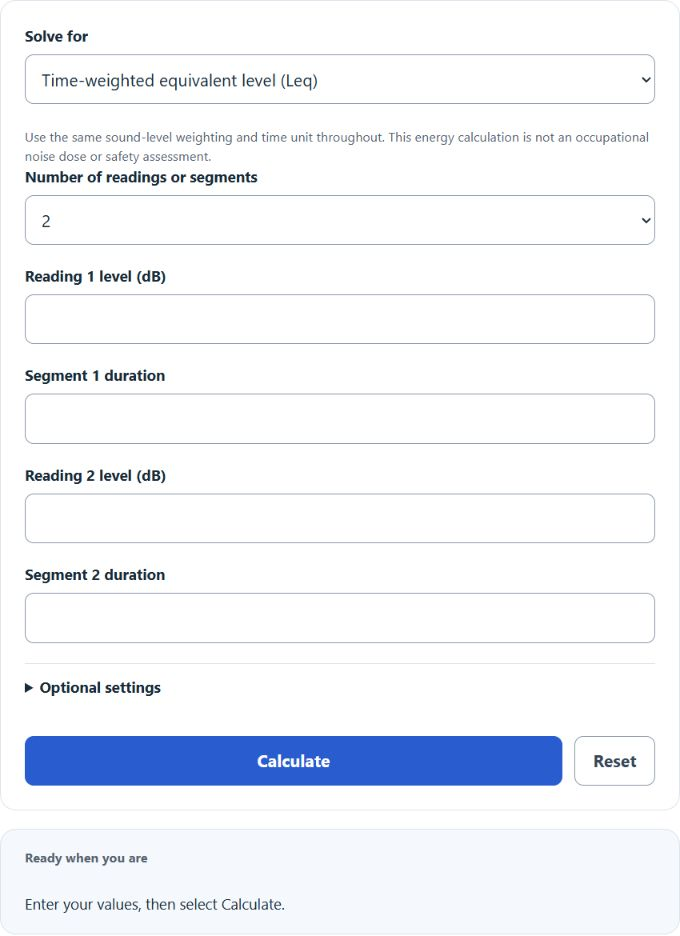
Calculate logarithmic time-weighted equivalent noise level, combine independent sound sources, or reverse a missing segment with energy and duration details.
Related Calculators
- dB Per Decade Calculator
- Delay Time Calculator
- Phasor Calculator
- Electrical Length Calculator
- All Physics Calculators
Average Noise Level Formulas
Because decibels are logarithmic, there are different “averages” depending on what you need: a simple arithmetic mean of readings (a descriptive statistic) or an energy-average such as Leq (commonly used for noise exposure over time).
Variables:
- Li is the i-th measured sound level (in dB, using the same weighting such as dB(A) for all readings)
- N is the number of measurements/readings
- L̄ is the arithmetic mean of the dB readings
- Ti is the duration associated with level Li (for Leq)
- Leq is the equivalent continuous (energy-average) sound level over the total time
Important: adding or averaging dB values arithmetically does not add or average the underlying acoustic energy. If you need an average that represents overall exposure over time, use Leq (energy averaging).
What is an Average Noise Level?
An “average noise level” can mean different things depending on context. A common descriptive statistic is the arithmetic mean of several dB readings (useful when values are close together). For noise exposure and many engineering/health applications, the more meaningful average is an energy-average such as Leq, which averages sound energy over time and reports the result in dB.
How to Calculate Average Noise Level?
The following steps outline how to calculate the Average Noise Level.
- Measure sound levels Li using a consistent weighting (for example, dB(A)).
- If you need an exposure/energy average, record the duration Ti for each level.
- Compute the energy-average using Leq: Leq = 10 log10((Σ Ti · 10Li/10) / (Σ Ti)).
- If you only need a simple statistic, compute the arithmetic mean: L̄ = (1/N) Σ Li. Then check your answer with the calculator above.
Example Problem :
Use the following variables as an example problem to test your knowledge.
Measurements (equal duration): 70 dB(A), 80 dB(A), 90 dB(A)
N = 3. Arithmetic mean = (70 + 80 + 90) / 3 = 80 dB(A). Energy average (log/Leq for equal durations) = 10 log10((107 + 108 + 109) / 3) ≈ 85.682 dB(A).