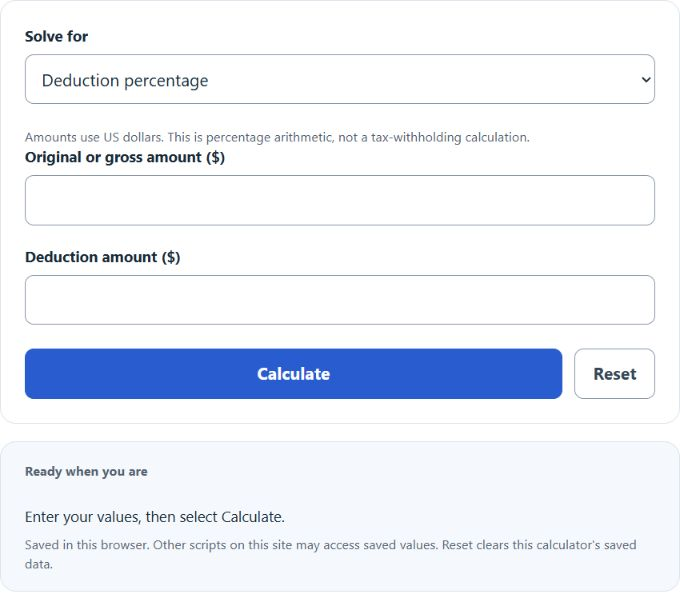
Calculate a deduction percentage from the original and deducted amounts, or find the deduction, the remaining amount or the original amount.
Deduction Percentage Formula
Variables:
- DP is the Deduction Percentage (%)
- TD is the total deductions ($)
- TS is the total salary ($)
To calculate the Deduction Percentage, divide the total deductions by the total salary, then multiply by 100.
How to Add Several Deductions
Select Total of several deductions to enter a gross amount and up to five deductions. Each entry can be a dollar amount or a percentage of that same gross amount; leave unused lines blank. The result shows the total deductions, total deduction percentage, net amount and an itemized breakdown.
For a percentage entry p, its deduction amount is gross × p ÷ 100. Add all dollar amounts and converted percentage amounts to get total deductions. Then total deduction percentage = total deductions ÷ gross × 100, and net amount = gross − total deductions. Each percentage uses the original gross amount, rather than the amount remaining after earlier deductions.
For example, with $2,000 gross and supplied deductions of 10%, $75 and 5%, the deduction amounts are $200, $75 and $100. Total deductions are $375 (18.75%), leaving $1,625. Use entries from the same period. This mode adds deductions you supply; it does not determine tax withholding, statutory rates, taxable bases or payroll rounding. Values are summed before display rounding to cents.
How to Calculate Deduction Percentage?
The following steps outline how to calculate the Deduction Percentage.
- First, determine the total deductions ($).
- Next, determine the total salary ($).
- Next, gather the formula from above = DP = TD / TS * 100.
- Finally, calculate the Deduction Percentage.
- After inserting the variables and calculating the result, check your answer with the calculator above.
Example Problem :
Use the following variables as an example problem to test your knowledge.
total deductions ($) = 5000
total salary ($) = 60000; deduction percentage = 5000 ÷ 60000 × 100 ≈ 8.333%.
Frequently Asked Questions (FAQ)
What is a Deduction Percentage?
Deduction Percentage is a financial metric that represents the portion of an individual’s total salary that is taken out as deductions. It is calculated by dividing the total deductions by the total salary and then multiplying by 100 to get a percentage.
Why is calculating Deduction Percentage important?
Calculating Deduction Percentage is important for financial planning and budgeting. It helps individuals understand how much of their salary is going towards deductions, which can include taxes, retirement contributions, and other withholdings. This understanding can help in making informed decisions about spending and saving.
Can Deduction Percentage affect my take-home pay?
Yes, the Deduction Percentage directly affects your take-home pay. A higher Deduction Percentage means more of your salary is allocated to deductions, reducing the amount of money you receive in your paycheck. Understanding your Deduction Percentage can help you anticipate your take-home pay and plan your finances accordingly.
How can I lower my Deduction Percentage?
Review the individual deductions on your pay statement. Payroll deductions, tax deductions and tax credits are different concepts; a retirement contribution can itself be withheld from pay. Changing tax withholding changes when tax is paid, not necessarily the total tax owed. The IRS recommends checking withholding because too little can lead to a tax bill or penalty. This calculator only measures a percentage; use the IRS withholding guidance or qualified payroll/tax advice for decisions.