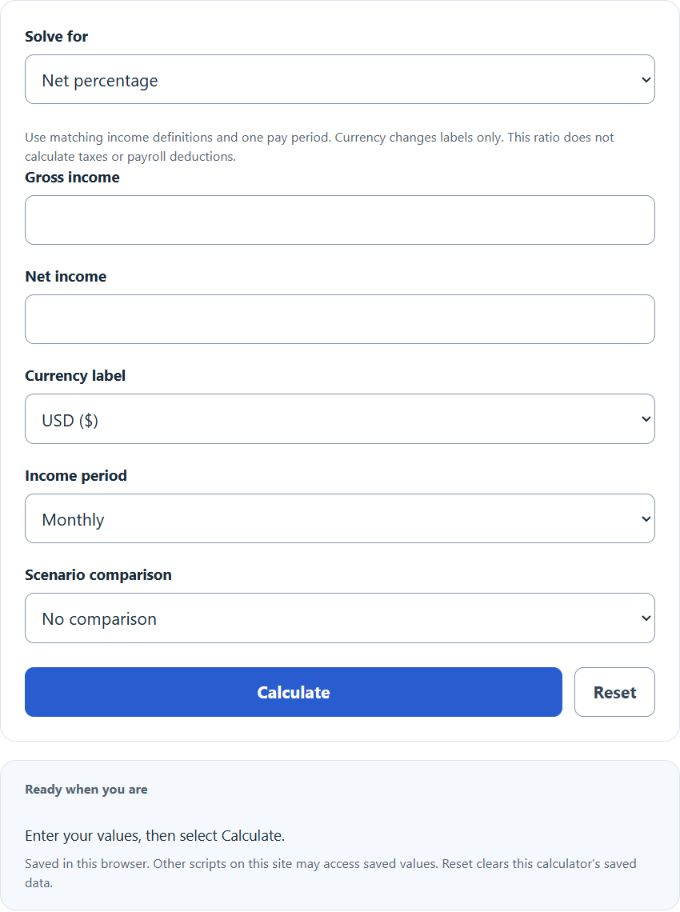
Calculate net income as a percentage of gross, reverse-solve net or gross income, and see deduction amount, retained share, annualized values, and scenario differences.
Net Percentage Formula
The net percentage measures how much of gross income remains after deductions, taxes, fees, or other reductions. It is commonly used for payroll, self-employment income, commissions, and business reporting to show the share of gross income that becomes net income.
- NP = net percentage
- N = net income
- G = gross income
With positive gross income, the formulas can solve for the selected unknown. Gross cannot be uniquely recovered from a zero net percentage; zero net income at zero percent allows many possible gross amounts.
How to Use the Net Percentage Calculator
- Select the value to solve for, then enter the two displayed amounts or percentage.
- Make sure gross and net income use the same currency and the same time period.
- Calculate the missing value.
- Interpret the result as the percentage of gross income that is actually retained.
For example, if you enter monthly gross income, the net income should also be monthly. If you enter annual values, both inputs should be annual.
What Gross Income and Net Income Mean
| Term | Meaning |
|---|---|
| Gross Income | For payroll, pay before deductions. Business revenue, gross profit and taxable gross income are different measures; choose a denominator consistent with the net amount. |
| Net Income | The amount left after deductions or expenses have been subtracted from gross income. |
| Net Percentage | The portion of gross income that remains as net income, expressed as a percent. |
How to Interpret the Result
| Result Range | Interpretation |
|---|---|
| 100% | Gross income and net income are equal. |
| Between 0% and 100% | Only part of the gross income remains after deductions or expenses. |
| Above 100% | Unusual case that may indicate credits, reimbursements, adjustments, or mismatched inputs. |
| Below 0% | Negative net income, which usually indicates a loss. |
Examples
If gross income is $5,000 and net income is $3,850, the net percentage is:
This means 77% of the gross income was retained as net income.
If gross income is $8,000 and the net percentage is 82%, the net income is:
The net income is $6,560.
If net income is $4,200 and the net percentage is 70%, the gross income is:
The gross income is $6,000.
Net Percentage vs. Deduction Percentage
Net percentage tells you how much income you keep. Deduction percentage tells you how much income is removed. When net income is lower than gross income because of deductions alone, the deduction percentage can be found with:
- DP = deduction percentage
- A higher net percentage means more income is retained.
- A higher deduction percentage means more income is being removed.
Common Uses
- Applying an already-known net share to matching gross pay; the calculator does not derive taxes from wages
- Comparing payroll deductions across jobs or pay periods
- Measuring how much contract or freelance income is retained after fees and taxes
- Reviewing business income after expenses
- Checking whether a projected net income is realistic compared to gross income
Important Notes
- Gross income cannot be zero when calculating net percentage.
- Gross and net values must use the same unit of measure and the same time frame.
- Net percentage is not automatically the same as tax rate, since net income may also reflect insurance, retirement contributions, fees, and operating expenses.
- Negative net income will produce a negative net percentage.
FAQ
What does net percentage tell you?
It shows the percentage of gross income that remains after deductions or expenses have been removed.
Can net income be greater than gross income?
In normal income calculations, this is uncommon. If it happens, it usually means there are credits, reimbursements, accounting adjustments, or inconsistent inputs.
Is net percentage useful for personal finance and business?
Yes, when the input definitions match. For payroll, gross and net pay differ by deductions. For business, revenue, gross profit and net income are distinct statement measures; identify which denominator your ratio uses. The calculator does not establish a tax rate or calculate payroll withholding.
Why is my result undefined?
If gross income is zero, the percentage cannot be calculated because division by zero is undefined.