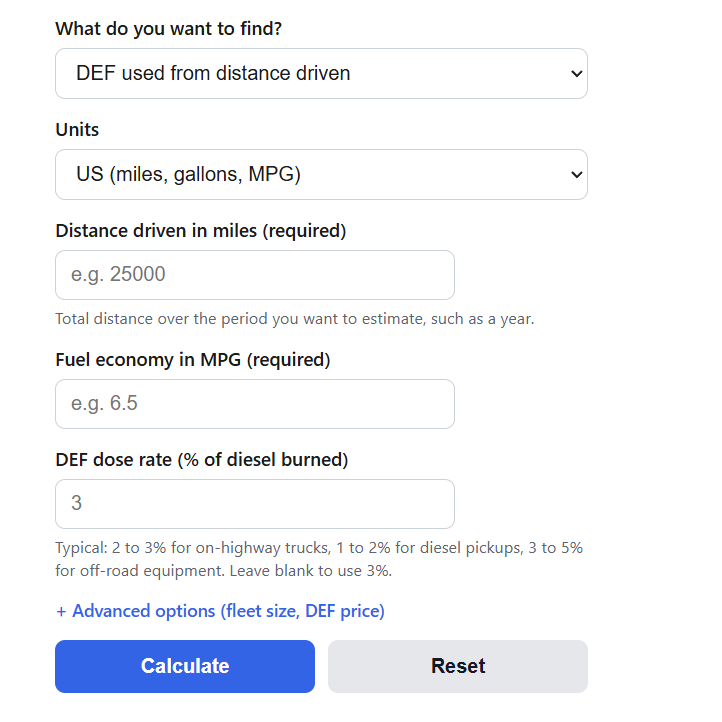
Calculate diesel exhaust fluid (DEF) consumption from miles driven or fuel burned, plus DEF cost and how far a full DEF tank will last.
DEF Consumption Formula
DEF = D * (r / 100)
D = M / MPG
Range = (T * 100 / r) * MPG
- DEF is the diesel exhaust fluid consumed (gallons or liters)
- D is the diesel fuel burned (gallons or liters)
- r is the DEF dose rate as a percent of diesel burned (typically 2 to 3)
- M is the distance driven (miles or kilometers)
- MPG is the fuel economy (miles per gallon, or L/100 km in metric mode)
- T is the DEF tank capacity (gallons or liters)
The calculator has three modes built on these formulas. The distance mode first converts miles driven into diesel burned using your fuel economy, then applies the dose rate to get DEF used. The fuel mode skips the first step and applies the dose rate directly to the diesel volume you enter. The tank range mode inverts the formula: it works out how much diesel can be burned before a full DEF tank runs dry, then converts that diesel into distance using your fuel economy. The advanced options multiply distance or fuel by a vehicle count for fleet estimates and apply a DEF price to estimate cost.
Typical DEF Dose Rates and Shelf Life
The dose rate is set by the engine’s SCR calibration, not by the driver. Use the ranges below as a starting point if you have not measured your own consumption.
| Application | Typical DEF dose rate | Rough rule of thumb |
|---|---|---|
| Diesel pickup (light duty) | 1 to 2% of diesel | 1 gal DEF per 50 to 100 gal diesel |
| On-highway semi truck | 2 to 3% of diesel | 1 gal DEF per 33 to 50 gal diesel |
| Off-road equipment | 3 to 5% of diesel | 1 gal DEF per 20 to 33 gal diesel |
| Transit and vocational trucks | 2 to 4% of diesel | 1 gal DEF per 25 to 50 gal diesel |
Consumption estimates are only useful if the DEF you stock stays in spec. DEF degrades with heat, so bulk buyers sizing purchases with this calculator should also check storage conditions against the ISO 22241 shelf life guidance below.
| Constant storage temperature | Expected DEF shelf life |
|---|---|
| Below 50 F (10 C) | 36 months |
| Below 77 F (25 C) | 18 months |
| Below 86 F (30 C) | 12 months |
| Below 95 F (35 C) | 6 months |
| Above 95 F (35 C) | Test before use |
Example Problems
Example 1: Annual DEF use for a semi truck. A truck runs 120,000 miles per year at 6.5 MPG with a 3% dose rate. Diesel burned is 120,000 / 6.5 = 18,461.54 gallons. DEF used is 18,461.54 * 0.03 = 553.85 gallons, or about 217 miles per gallon of DEF. At $12.50 per gallon of DEF, that is roughly $6,923 per year.
Example 2: DEF tank range for a pickup. A diesel pickup has a 5 gallon DEF tank, gets 20 MPG, and doses at 2%. Diesel burned per DEF tank is 5 * 100 / 2 = 250 gallons. Range is 250 * 20 = 5,000 miles per full DEF tank, so topping off at every oil change comfortably keeps the tank from running low.
FAQ
How much DEF does a truck use per gallon of diesel? Most on-highway diesel engines inject DEF at 2 to 3% of diesel consumption, which works out to about 1 gallon of DEF for every 33 to 50 gallons of diesel. Light-duty pickups often run closer to 1 to 2%, while hard-working off-road equipment can reach 3 to 5%. Load, terrain, and idle time all push the rate up or down, so treat the calculator output as a planning estimate and refine it once you can compare actual DEF purchases against fuel receipts.
What happens if the DEF tank runs empty? The truck will not stop immediately, but it will warn you well in advance and then progressively derate. Most systems limit engine power once DEF is nearly gone and restrict speed, sometimes to as little as 5 mph, after the tank is empty and the vehicle restarts. That is why the tank range mode in this calculator shows a refill point with a 10% reserve rather than the full theoretical range.
Does using more DEF mean worse fuel economy? No. DEF consumption tracks NOx production, not efficiency. SCR systems actually let engines be tuned for better combustion, which is why SCR-equipped engines typically get 3 to 5% better fuel economy than comparable engines without the system. Rising DEF use usually reflects heavier loads or higher engine output rather than a problem, although a sudden unexplained jump can indicate a dosing system fault worth checking.