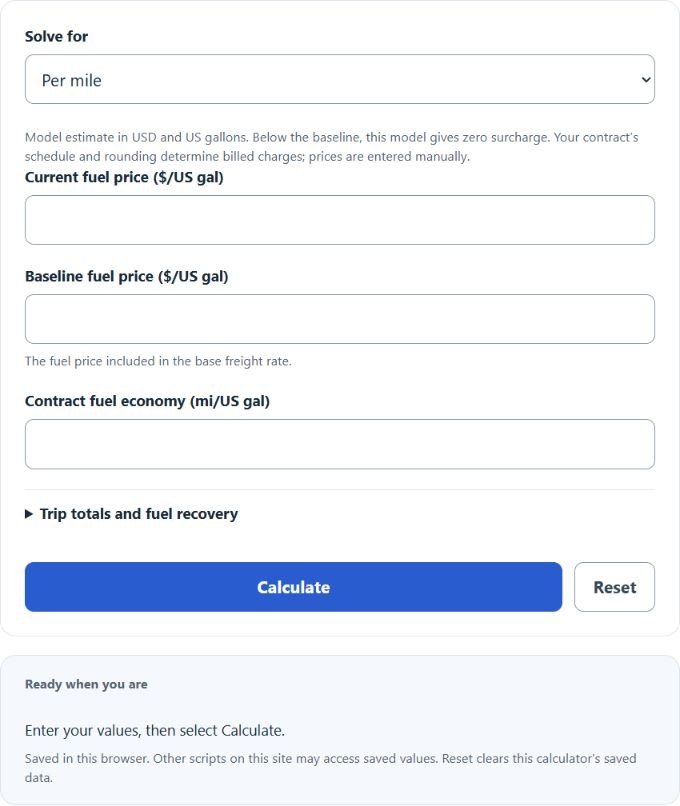
Model a fuel surcharge per mile or as a linear percentage of linehaul using the price index, baseline and calculation terms you supply. These estimates do not reproduce every carrier schedule or determine the amount payable under a contract.
Fuel Surcharge Formula
FSC = max(0, DP - BP) / MPG
TS = FSC * M
FSC% = max(0, DP - BP) * S
- FSC is the fuel surcharge in dollars per mile
- DP is the supplied current or contract-index diesel price (USD/US gal)
- BP is the supplied baseline fuel price for the modeled agreement (USD/US gal)
- MPG is the positive miles-per-US-gallon value specified for the model; no universal 6 MPG value is assumed
- TS is the total surcharge for the trip ($)
- M is the trip distance in miles
- FSC% is the surcharge as a percentage of the linehaul charge
- S is the supplied number of percentage points of linehaul added per USD 1.00/US gal above baseline; for example, enter 20 for 20 percentage points
Both modes first use max(0, DP – BP), so this model returns zero when the supplied price is at or below baseline. That floor is a modeling rule, not a statement about every contract. In per-mile mode, divide the nonnegative price difference by the supplied MPG. Optional trip miles give the trip surcharge; with a base rate, the calculator also reports the modeled linehaul-plus-surcharge amount before other charges. Optional actual MPG estimates fuel-price-increase cost per mile as max(0, DP – BP) / actual MPG; supplied trip miles also give a trip cost. With a positive price increase, per-mile recovery is actual MPG / contract MPG * 100%, independently of trip miles. It is unavailable when there is no price increase. In percentage mode, multiply the nonnegative price difference by the supplied escalator, then apply that percentage to an optional linehaul amount. Current price, baseline and the mode-specific MPG or escalator must be entered; the calculator does not supply market prices or contract terms.
Fuel Surcharge Rate Chart and Method Comparison
This hypothetical chart uses a USD 3.00/US gal baseline and a supplied 6 MPG solely to illustrate the per-mile model. At those assumptions, a USD 0.06/US gal increase above baseline adds USD 0.01 per mile. These are example inputs, not recommended defaults or current prices. Trip totals use unrounded per-mile values, with displayed values rounded independently.
| Hypothetical diesel price (USD/US gal) | Modeled surcharge per mile | Modeled surcharge on 500 miles |
|---|---|---|
| $3.00 or below | $0.00 | $0 |
| $3.25 | $0.042 | $21 |
| $3.50 | $0.083 | $42 |
| $3.75 | $0.125 | $63 |
| $4.00 | $0.167 | $83 |
| $4.25 | $0.208 | $104 |
| $4.50 | $0.250 | $125 |
| $4.75 | $0.292 | $146 |
| $5.00 | $0.333 | $167 |
The comparison below describes the two formulas in this calculator. Use a mode only when its assumptions match the applicable agreement. Actual carrier schedules may instead use price bands, different indexes, effective-date lags, minimums or different charge bases. For example, the published FedEx and UPS schedules use service-specific index tables; this calculator is not a lookup tool for those schedules.
| Modeled term | Per-mile method | Linear percentage-of-linehaul method |
|---|---|---|
| Applies when | The agreement uses the supplied price difference and MPG per mile | The agreement uses the supplied linear escalator |
| How it scales | Price increase divided by MPG; optional total scales with miles | Price increase multiplied by escalator; optional amount scales with linehaul |
| Required inputs | Current price, baseline and MPG | Current price, baseline and escalator |
| Optional outputs | Trip surcharge, modeled rate/total and increase-cost recovery | Surcharge dollars and linehaul-plus-surcharge amount |
| Limits | Actual fuel-price-increase cost depends on actual MPG; other costs are excluded | Does not reproduce a stepped carrier table or include other charges |
Fuel Surcharge Example Problems
Example 1: Per-mile surcharge. For a hypothetical agreement, enter a USD 3.00/US gal baseline, a USD 4.20/US gal index price and 6 MPG. These are example terms, not this week’s EIA price or calculator defaults. The price increase is max(0, 4.20 – 3.00) = USD 1.20/US gal; 1.20 / 6 = USD 0.20 per mile. For 500 supplied trip miles, the surcharge is 0.20 * 500 = USD 100. With a USD 2.50-per-mile base rate, the modeled combined rate is USD 2.70 per mile and linehaul plus surcharge totals USD 1,350, before any other charges. If actual fuel economy is 5.5 MPG, the price-increase-only cost is 1.20 * 500 / 5.5 = about USD 109.09 and modeled recovery is about 91.67%.
Example 2: Linear percentage-of-linehaul surcharge. Suppose a hypothetical agreement specifies a USD 3.00/US gal baseline and 20 percentage points of linehaul per USD 1.00/US gal increase. Enter those terms and a hypothetical USD 4.00/US gal index price. The difference is max(0, 4.00 – 3.00) = USD 1.00/US gal, so the modeled surcharge is 1.00 * 20 = 20% of linehaul. On an optional USD 1,800 linehaul amount, the surcharge is USD 360 and linehaul plus surcharge is USD 2,160, before other charges. This linear example does not reproduce a carrier’s stepped price-band schedule.
Fuel Surcharge Frequently Asked Questions
Which diesel price should you use? Use the index, geographic series, price date, lag and adjustment frequency specified by the applicable agreement. The EIA explains that it publishes price data but does not calculate or endorse a fuel-surcharge method. Its national and regional weekly diesel series may be relevant when the agreement calls for them; verify the required observation and the current EIA release schedule. This calculator does not fetch prices or update a carrier surcharge.
Does this calculator determine the surcharge you owe? No. Check the applicable customer agreement, carrier tariff and service-specific surcharge schedule for the charge base, index, timing, bands, minimums and any credits. Use this calculator only when its per-mile or linear-percentage assumptions match those terms; it does not determine contractual entitlement, whether a surcharge is included in an all-in rate, or the full amount payable.
What does the recovery percentage measure? With actual MPG supplied in per-mile mode, recovery compares surcharge per mile with extra fuel cost per mile caused only by a price increase above baseline. Trip miles are not needed for this per-mile ratio; zero trip miles produce zero trip totals. It does not compare against the total fuel bill, other expenses or profit. For a positive increase, lower actual MPG than the modeled MPG produces recovery below 100%; higher actual MPG produces recovery above 100%. When the current price is at or below baseline, the modeled increase cost and surcharge are zero, and recovery is unavailable because the ratio would divide zero by zero. Contract credits, minimums or other rules may differ from this model.