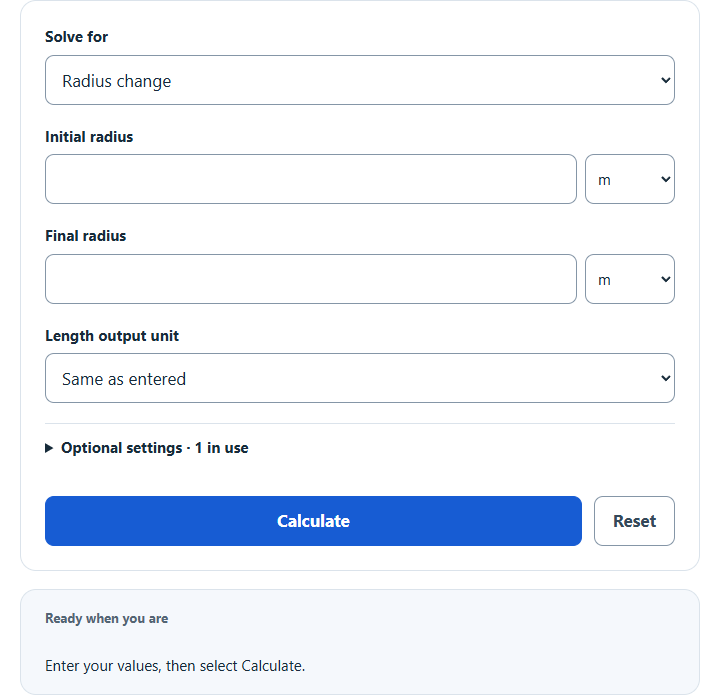
Calculate delta radius, the change from an initial to a final radius, or solve for either radius or the average rate of change in m, cm, mm, in or ft.
- All Math and Numbers Calculators
- Chord To Radius Calculator
- Arc Length Calculator
- Top Chord Length Calculator
Delta Radius Formula
The calculator uses signed radius change and average rate:
Variables:
- r₁ is initial radius; r₂ is final radius (nonnegative lengths)
- Δr is signed radius change (final minus initial)
- t is positive elapsed time when a rate is calculated
- v is radius-change rate; r₂ = r₁ + vt assumes a constant rate
Subtract initial radius from final radius to find Δr. Positive means expansion; negative means contraction. Optional elapsed time adds average rate. The calculator also compares ideal circle areas, ΔA = π(r₂² − r₁²), and sphere volumes, ΔV = 4π(r₂³ − r₁³)/3. Relative radius change is 100Δr/r₁ and is undefined when r₁ is zero.
What is a Delta Radius?
Delta radius here means the change in radius between two states, not the radius of an arc inferred from a chord. Choose one of the five modes for radius change, initial radius, final radius, final radius from rate and time, or average rate.
How to Calculate Delta Radius?
The following steps outline how to calculate the Delta Radius.
- Choose the quantity to solve for.
- Enter the requested radii, signed change or rate, and their units.
- Enter positive elapsed time for rate modes; in Radius change mode it is optional.
- Choose output units and select Calculate. Negative computed radii are invalid.
- After inserting the variables and calculating the result, check your answer with the calculator above.
Example Problem:
Use the following variables as an example problem to test your knowledge.
Initial radius r₁ = 5 m
Final radius r₂ = 8 m. Thus Δr = 8 − 5 = 3 m, diameter change = 6 m, and relative radius change = 60%. Over 6 seconds the average radius-change rate is 0.5 m/s.