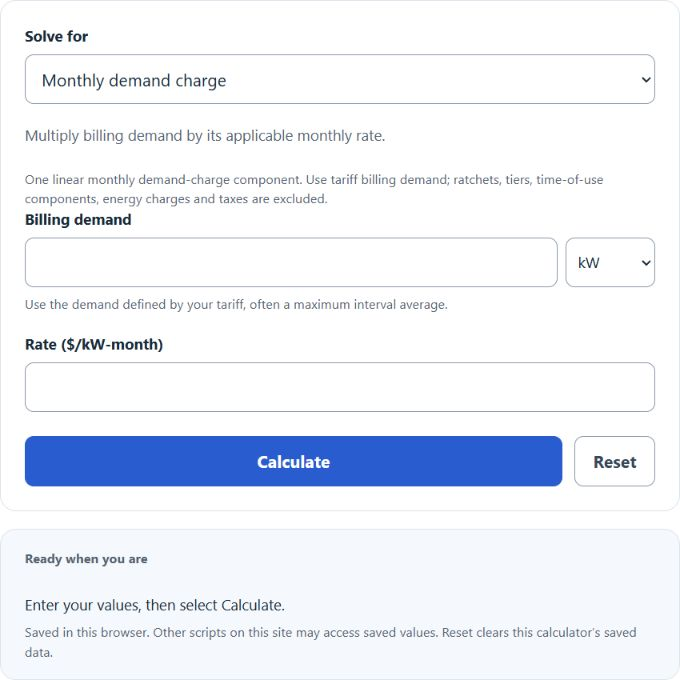
Calculate one monthly demand-charge component from tariff billing demand and its $/kW-month rate, or solve for demand or rate from that charge amount.
Related Calculators
- Total Cost Calculator
- Allocated Cost Calculator
- Indirect Costs Calculator
- Variable Margin Calculator
- All Business Calculators
Demand Charge Formula
The demand charge is based on your highest measured demand during the billing demand interval, commonly a 15-minute period. The calculator uses kilowatts as the base demand unit.
- DC = demand charge in dollars per month
- DkW = maximum demand in kilowatts
- R = demand charge rate in dollars per kW-month
Choose the value to calculate, then enter the other two values. The demand result represents the billing demand used by the entered charge component; zero denominators do not determine a unique inverse.
When maximum demand is entered in watts or megawatts, it is converted to kilowatts before the formula is applied.
Demand Unit Conversions and Illustrative Rate Examples
Use these tables to check whether the units and results are in a reasonable range.
| Entered Unit | Conversion to kW | Example |
|---|---|---|
| Watts (W) | W × 0.001 | 50,000 W = 50 kW |
| Kilowatts (kW) | kW × 1 | 50 kW = 50 kW |
| Megawatts (MW) | MW × 1,000 | 0.05 MW = 50 kW |
| Demand Charge Rate | 50 kW Demand | 250 kW Demand |
|---|---|---|
| $5/kW-month | $250/month | $1,250/month |
| $10/kW-month | $500/month | $2,500/month |
| $20/kW-month | $1,000/month | $5,000/month |
Example Demand Charge Calculations
Example 1: Calculate the demand charge
You have a maximum demand of 120 kW and a demand charge rate of $14/kW-month.
The demand charge is $1,680 per month.
Example 2: Calculate maximum demand
Your demand charge is $900 per month and the demand charge rate is $12/kW-month.
The maximum demand is 75 kW.
FAQ
What is a demand charge?
A demand charge is based on billing demand as defined by the utility tariff, often the highest interval-average power. The interval may be 15 minutes or another tariff-defined duration. Billing demand may also include ratchets or adjustments. This calculator accepts the applicable demand and computes one linear component, separate from kilowatt-hour energy charges.
Why is the demand charge rate shown as $/kW-month?
The rate is charged for each kilowatt of peak demand during the billing month. For example, if your peak demand is 100 kW and your rate is $15/kW-month, your demand charge is 100 × 15, or $1,500 for that month.
Can maximum demand be entered in watts or megawatts?
Yes. The calculator converts watts and megawatts to kilowatts before calculating the result. Watts are divided by 1,000, and megawatts are multiplied by 1,000.