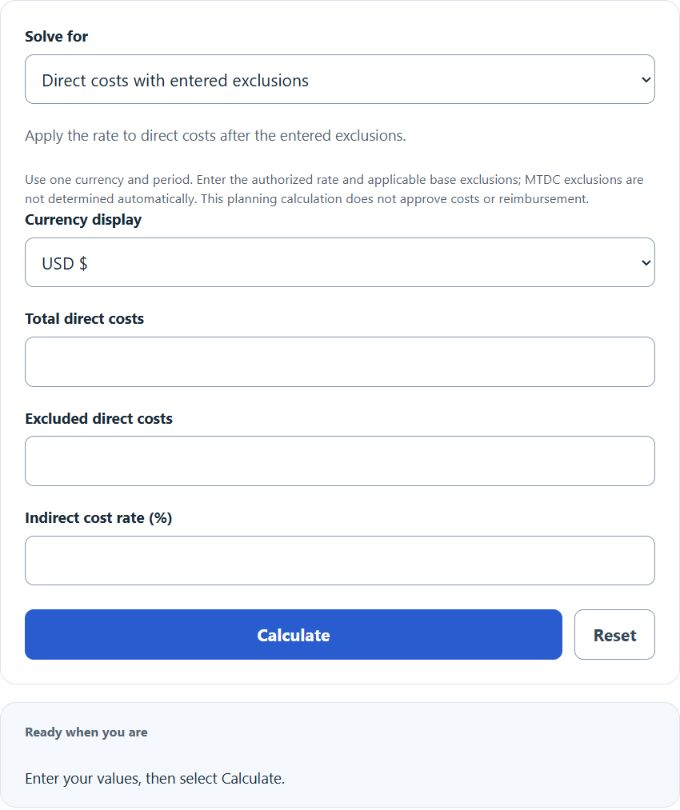
Calculate indirect costs from a direct-cost base, apply entered exclusions (including an applicable MTDC base), or fit direct and indirect costs inside a fixed budget. Select exclusions using the applicable agreement; this tool does not determine them automatically.
- All Business Calculators
- Budget Variance Calculator
- Direct Labor Costs Calculator
- Economic Impact Calculator
- Indirect Cost Rate Calculator
Indirect Costs Formula
The following formula is used to calculate the indirect costs of a budget preparation.
- Where IC is the indirect costs ($)
- SOR is the sponsors’ overhead rate (%)
- DC is the direct cost base ($)
To calculate indirect costs, divide the percentage rate by 100 and multiply by the applicable direct cost base after any required exclusions.
Indirect Costs Definition
Indirect costs are defined as project-related costs that cannot easily be identified for a particular project. In other words, these are the overhead costs of a project.
How to calculate indirect costs?
Example Problem #1:
First, identify the applicable overhead rate. This arithmetic example uses an assumed rate of 50%; it does not establish a sponsor-approved rate.
Next, determine the direct cost base. The direct cost base of this planned project is budgeted to be $100,000.00.
Finally, calculate the indirect costs using the formula above:
IC = SOR/100 * DC
= 50/100 * $100,000.00
= $50,000.00.
Example Problem #2:
In this next example, the sponsor’s overhead rate is much higher, at 87% of direct costs.
The direct costs of this project are also higher at $200,000.00.
Using the formula as we did above, the indirect costs are calculated as follows:
IC = SOR/100 * DC
= 87/100*200,000
= $174,000.00.