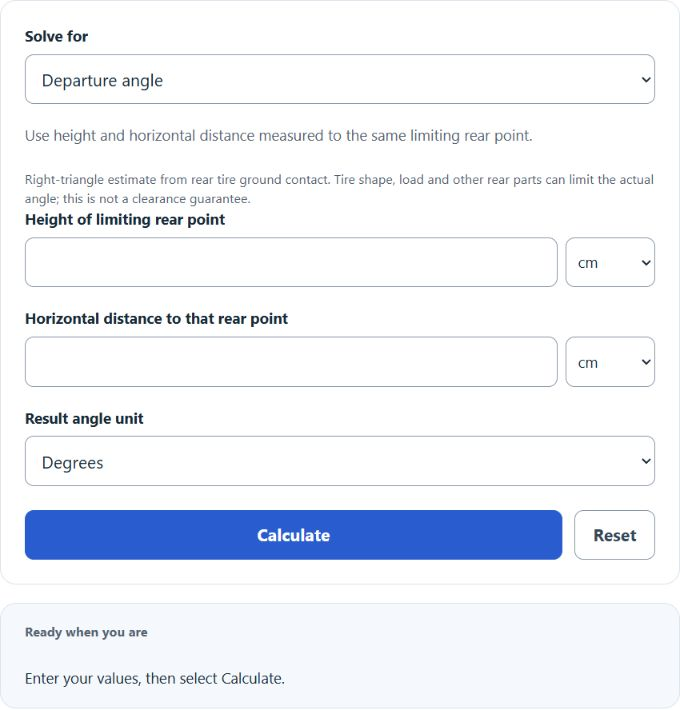
Calculate departure angle, rear ground clearance, or rear overhang by choosing the value to solve and entering the other two in degrees or radians and common length units.
Related Calculators
- Breakover Angle Calculator
- Wheel Over Point Calculator
- Tire Rollout Calculator
- Wheel Rate Calculator
- All Automotive Calculators
Departure Angle Formula
The departure angle is based on a right triangle formed by the rear ground clearance and the rear overhang. The calculator can solve for departure angle, ground clearance, or rear overhang when you enter the other two values.
- DA = departure angle
- GC = rear ground clearance
- RO = rear overhang
- arctan = inverse tangent function
- tan = tangent function
The calculator converts length inputs to a common unit before applying the formula. Angles are calculated internally in radians, then converted to degrees or radians based on the result angle unit.
- To calculate departure angle: enter rear ground clearance and rear overhang.
- To calculate ground clearance: enter departure angle and rear overhang.
- To calculate rear overhang: enter departure angle and rear ground clearance.
Typical Departure Angle Ranges
Departure angle varies by vehicle shape, suspension height, bumper design, and rear overhang length. These illustrative ranges are not manufacturer specifications or safe ramp limits.
| Vehicle type | Typical departure angle | General meaning |
|---|---|---|
| Low passenger car | 10° to 16° | More likely to scrape on steep driveways or ramps |
| Crossover or small SUV | 17° to 25° | Moderate clearance for everyday slopes |
| Off-road SUV or truck | 26° to 40°+ | Better ability to exit steep obstacles without rear contact |
Length Unit Conversions Used
| Unit | Equivalent in centimeters |
|---|---|
| 1 cm | 1 cm |
| 1 m | 100 cm |
| 1 in | 2.54 cm |
| 1 ft | 30.48 cm |
Example Problems
Example 1: Calculate departure angle
You have a rear ground clearance of 35 cm and a rear overhang of 90 cm.
The departure angle is about 21.25°.
Example 2: Calculate rear overhang
You have a departure angle of 25° and a rear ground clearance of 40 cm.
The rear overhang is about 85.78 cm.
FAQ
What is departure angle?
Departure angle is the steepest angle a vehicle can drive off from without the rear bumper, hitch, exhaust, or another rear part touching the ground. A larger departure angle generally means the vehicle can leave steeper ramps or obstacles without scraping.
How do you measure rear overhang?
Rear overhang is the horizontal distance from the rear tire contact point to the lowest rear point that could hit the ground. For many vehicles, this may be the bumper, tow hitch, spare tire carrier, or exhaust tip. Use the height and horizontal distance of the same point. Check each possible contact point: the smallest calculated angle governs. The simplified ground-contact triangle does not reproduce a loaded-tire tangent measurement.
Why does a shorter rear overhang increase departure angle?
With the same ground clearance, a shorter rear overhang makes the triangle steeper. Since the formula is DA = arctan(GC / RO), reducing RO increases the ratio, which increases the departure angle.