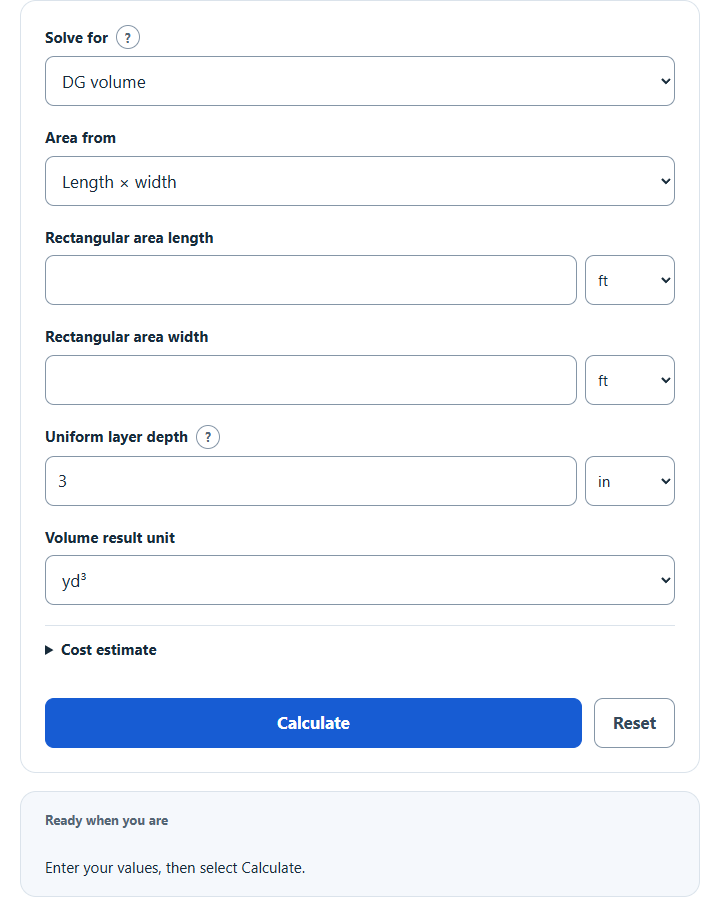
Calculate how much decomposed granite (DG) you need in cubic yards from length and width or square feet and depth, with an optional cost estimate.
- All Construction Calculators
- Granite Weight Calculator
- Flagstone Weight Calculator
- Limestone Weight Calculator
DG (Decomposed Granite) Formula
The calculator treats the project as a rectangular layer with uniform depth. Internally, dimensions are converted to meters and volume to cubic meters, then the result is converted to your selected unit. The following equivalent formula uses feet, inches and cubic yards:
- DG = decomposed granite amount in cubic yards
- L = length in feet
- W = width in feet
- D = depth in inches
- 12 = inches per foot
- 27 = cubic feet per cubic yard
Select volume or the dimension to calculate, then enter the displayed inputs (length and width, or a known area in square feet). To solve for a dimension, the same volume formula is rearranged:
- Calculate DG: enter length, width, and depth to find the decomposed granite volume.
- Calculate length: enter width, depth, and DG amount to find the missing length.
- Calculate width: enter length, depth, and DG amount to find the missing width.
- Calculate depth: enter length, width, and DG amount to find the missing depth.
Common DG Depths by Project Type
The ranges below are illustrative planning examples, not installation specifications. Required layer and base depths depend on the product, traffic and project design. Follow the supplier’s guidance and allow separately for compaction and waste.
| Project type | Illustrative depth | Notes |
|---|---|---|
| Light landscape cover | 1 to 2 in | Used for decorative areas with little traffic. |
| Garden path or walkway | 2 to 3 in | Common for compacted pedestrian paths. |
| Patio or seating area | 3 to 4 in | Often compacted in lifts for a firmer surface. |
| Driveway shoulder or heavier use | 4 to 6 in | May require a prepared base layer. |
DG Volume Conversion Reference
| Unit | Equivalent |
|---|---|
| 1 cubic yard | 27 cubic feet |
| 1 cubic foot | 0.037037 cubic yards |
| 1 cubic meter | 1.30795 cubic yards |
| 1 cubic yard | 0.764555 cubic meters |
Example Problems
Example 1: Calculate DG needed
You have a path that is 20 ft long, 4 ft wide, and 3 in deep.
You need about 0.7407 cubic yards of decomposed granite before adding any extra allowance.
Example 2: Calculate depth
You have 2 cubic yards of DG for an area that is 18 ft long and 9 ft wide.
The DG will cover the area at a depth of 4 inches.
FAQ
Should you add extra decomposed granite for compaction?
Compaction and waste require a separate, product-specific allowance. This calculator reports geometric volume only. Obtain the loose-to-finished yield and ordering allowance from your supplier or project specification rather than applying a universal percentage.
What depth should you use for decomposed granite?
Use the finished layer depth specified for your material, expected traffic and base preparation. The example depth ranges above do not replace product-specific installation requirements.
Does the calculator account for irregular shapes?
The calculator uses a rectangular area formula. For an irregular project, split the space into smaller rectangles, calculate each section, and add the results together. For curved or uneven edges, add an extra allowance to reduce the risk of running short.