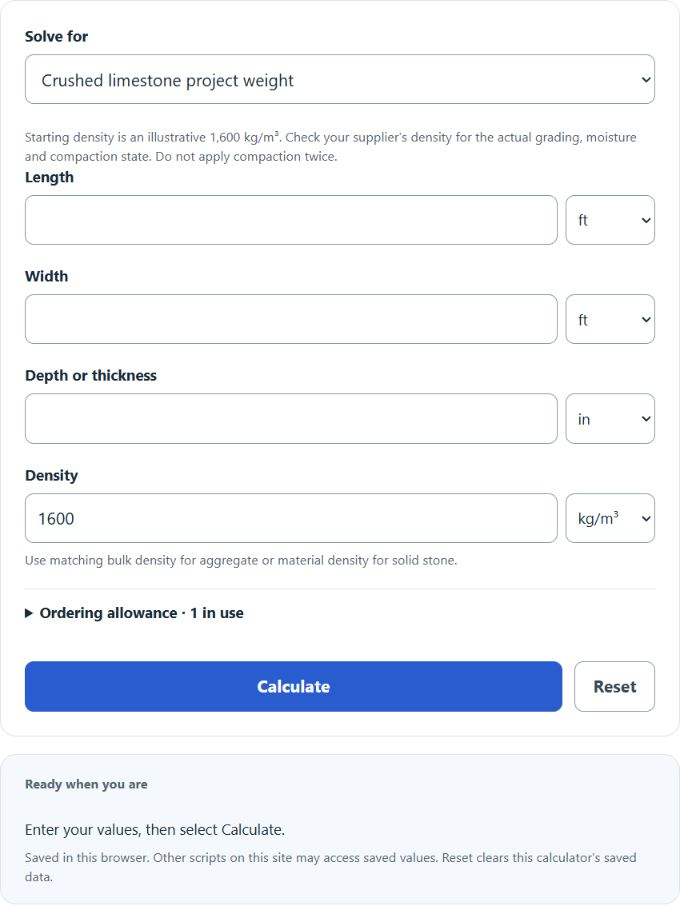
Calculate crushed limestone project weight, solid slab or block weight, or area covered by a known weight. Use dimensions and density that match the material’s actual state, with quantity and an optional ordering allowance where shown.
- All Construction Calculators
- Stone Calculator
- All Weight Calculators
- Granite Weight Calculator
- Marble Weight Calculator
Limestone Weight Formula
The calculator uses three formulas, one per mode.
Project amount (crushed limestone over an area):
Single piece (solid block or slab):
Coverage from weight (area a known tonnage will cover):
- L = length
- W = width
- D = depth (project and coverage modes)
- T = thickness (single piece)
- Q = number of pieces
- ρ = matching bulk or solid limestone density, in kg/m³ when using SI dimensions
- waste = waste allowance as a percent
All lengths are converted to meters, mass to kilograms, and density to kg/m³ internally. One US short ton is exactly 2,000 lb; one pound is exactly 0.45359237 kg. For the formulas above use consistent SI units, so weight denotes mass in kilograms, lengths are meters and area is square meters. The material must fill the stated volume uniformly. Compaction changes bulk density and volume; it does not increase the dry mass of the same material.
The project amount mode multiplies area by depth to get volume, then applies density and waste to return tons, pounds, kilograms, and cubic yards. The single piece mode treats each stone as a rectangular prism and multiplies by quantity. The coverage mode inverts the project formula: it divides available weight by density and depth to find the area it will fill.
Limestone Density and Coverage Tables
Density depends on grading, moisture, voids and compaction as well as the stone itself. The following table contains illustrative assumptions, not product specifications. The tool’s starting density and suggestions are also assumptions; replace them with supplier data for your material.
| Limestone form | lb/ft³ | kg/m³ | tons/yd³ |
|---|---|---|---|
| Solid limestone | 162 | 2,595 | 2.19 |
| Crushed, compacted | 120 | 1,922 | 1.62 |
| Crushed, loose | 90 | 1,442 | 1.22 |
| Riprap / large rock | 100 | 1,602 | 1.35 |
The next table shows how far one US ton of compacted crushed limestone (120 lb/ft³) goes at common depths.
| Depth | Coverage per ton | Tons per 100 ft² |
|---|---|---|
| 2 in | 100 ft² | 1.00 |
| 3 in | 67 ft² | 1.50 |
| 4 in | 50 ft² | 2.00 |
| 6 in | 33 ft² | 3.00 |
| 12 in | 17 ft² | 6.00 |
Worked Examples and Common Questions
Example 1: Driveway base. Using an explicitly entered density of 120 lb/ft³, a 40 ft by 10 ft area at 4 in depth has 133⅓ ft³ of volume and 16,000 lb of estimated mass (8 US short tons). A 10% ordering allowance gives 8.8 US short tons. Confirm the allowance and density with your supplier.
Example 2: Patio stone. Using an entered density of 162 lb/ft³, a 4 ft by 2 ft by 3 in slab has 2 ft³ of volume and an estimated 324 lb mass. Do not infer a safe number of people to lift it from this estimate; use an appropriate handling assessment and equipment.
Example 3: Coverage check. With a 0% allowance and an entered density of 120 lb/ft³, 5 US short tons gives 83⅓ ft³. At 3 in depth this covers about 333.3 ft². A square of that area would have sides about 18.26 ft.
How much allowance should you add? The tool starts at an illustrative 10%; it is not a universal recommendation. Use an allowance appropriate to your project and supplier. If density already represents the compacted state, avoid counting compaction again as extra waste.
Why is loose bulk density lower? Loose aggregate contains more air voids. Compaction can reduce the occupied volume of a fixed dry mass, increasing bulk density. The amount depends on the grading and compaction process; the illustrative table is not a universal ratio.
Tons or cubic yards: which should you order? Most quarries sell by the ton because trucks are weighed at the scale. Cubic yards are useful for visualizing the pile. The calculator returns both.
Does limestone weight change when wet? Retained water adds mass. The amount depends on moisture and drainage, so use a density or moisture adjustment supplied for the actual material rather than assuming one universal percentage.