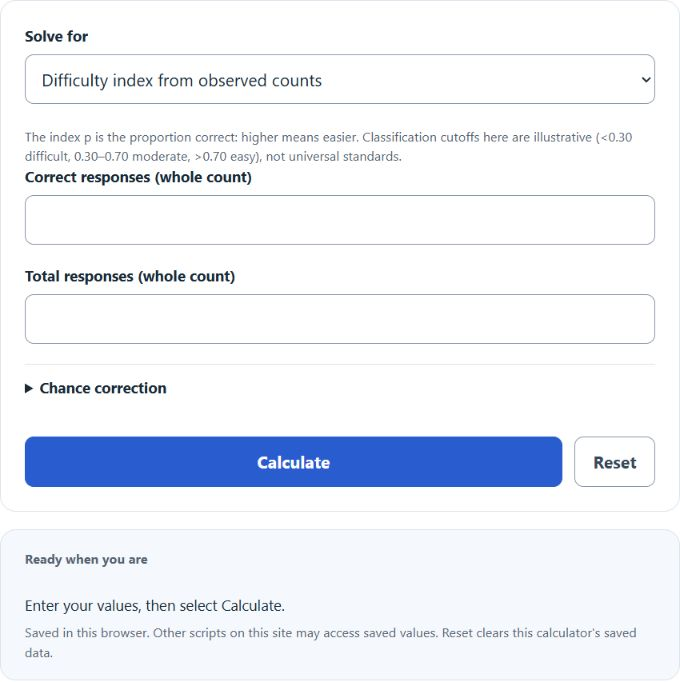
Calculate an item’s difficulty index from observed counts or normalized average score, reverse-solve targets, and review clearly labeled classification and uncertainty. Chance correction is optional.
Related Calculators
- Pass Rate Calculator
- Scaling (Curving) Grades Calculator
- Academic Index Calculator
- Step 2 Percentile Calculator
- All Statistics Calculators
Difficulty Index Formula
The following formula is used to calculate an item’s difficulty index (often denoted p, the proportion correct).
Variables:
- DI (or p) is the item difficulty index (proportion correct), from 0 to 1 (higher = easier item).
- K is the number of examinees who answered the item correctly (dichotomous scoring).
- N is the total number of examinees who responded to the item.
- For polytomous items, a common normalized form is p = (average item score) ÷ (maximum points) so the result is still on a 0–1 scale.
To calculate the difficulty index for a dichotomous item, divide the number correct by the total responses. For polytomous items, divide the average item score by the maximum possible points.
What is a Difficulty Index?
In educational and psychological measurement, the difficulty index (often called the item p-value) summarizes how easy or hard a test item was for a group of examinees. It is typically the proportion of examinees who answered correctly (for right/wrong items), so values closer to 1 indicate an easier item and values closer to 0 indicate a harder item.
How to Calculate Difficulty Index?
The following steps outline how to calculate the Difficulty Index.
- Enter the total number of responses (N).
- For dichotomous items, enter the number correct (K). For polytomous items, switch modes and enter the average item score and the maximum points.
- Compute DI (p) using DI = K ÷ N (dichotomous) or p = average score ÷ max points (polytomous).
- Interpret the result: higher p means an easier item. The calculator uses illustrative categories: p < 0.30 difficult, 0.30 ≤ p ≤ 0.70 moderate, and p > 0.70 easy. Cutoffs vary by assessment purpose and are not universal standards.
- Observed whole-count mode provides an approximate 95% Wilson interval and binomial standard error under independent comparable binary-response assumptions. Optional chance correction assumes equally likely guesses and no omitted responses. Reverse or normalized-score modes do not infer a binomial interval; this calculator does not compute item discrimination or distractor performance.
Example Problem :
Use the following variables as an example problem to test your knowledge.
Total Responses (N) = 100
Number Correct (K) = 42
Difficulty Index (DI = p) = 42 ÷ 100 = 0.42 (42%), which would be classified as Moderate using this calculator’s illustrative thresholds of 0.30 and 0.70.