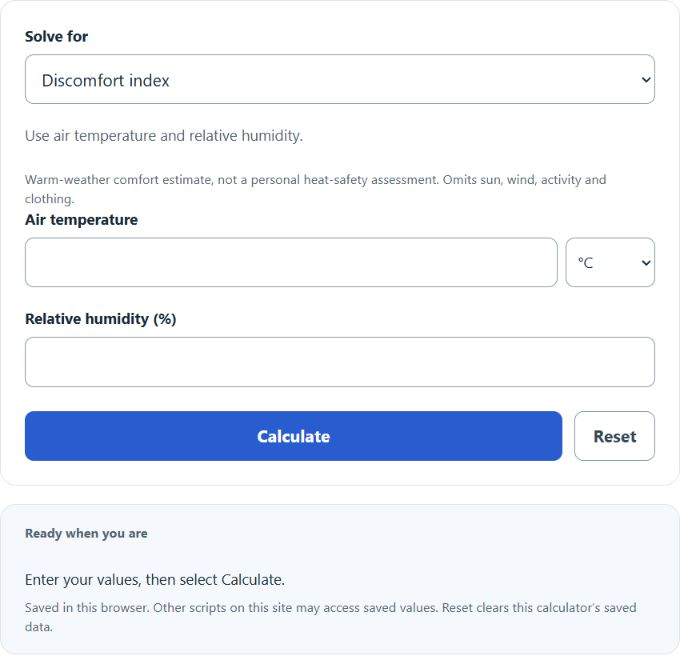
Choose discomfort index, air temperature, or relative humidity as the unknown. Temperature inputs support °C or °F; the index uses the Celsius scale.
Discomfort Index Formula
The formula uses air temperature in degrees Celsius and relative humidity as a percent. Choose the unknown and enter the other two values. Fahrenheit temperature inputs are converted to Celsius.
- DI = discomfort index
- T = air temperature in degrees Celsius
- RH = relative humidity as a percentage
- f = humidity adjustment factor used when solving for air temperature
To calculate the discomfort index, the formula adjusts the air temperature based on humidity. For temperatures above 14.5°C, increasing humidity raises the calculated index toward the air temperature. This empirical warm-weather estimate does not assess an individual’s safe heat exposure.
To calculate air temperature, the same formula is rearranged so that temperature is the unknown value. To calculate relative humidity, the formula is rearranged so that humidity is the unknown value.
Discomfort Index Ranges
These literature bands describe warm-weather population discomfort, not personal safety limits. The model is commonly applied to air temperatures of about 21–47°C. Sun, wind, activity, clothing and individual health can change actual effects.
| Discomfort Index | Typical Interpretation |
|---|---|
| Below 21 | Generally comfortable for most people |
| 21 ≤ DI < 24 | Some people may begin to feel discomfort |
| 24 ≤ DI < 27 | Many people feel discomfort |
| 27 ≤ DI < 29 | Most people feel uncomfortable |
| 29 ≤ DI < 32 | Severe discomfort is likely |
| 32 or higher | Highest discomfort band in this classification; not an individual medical assessment |
Example Calculations
Example 1: Calculate discomfort index
Suppose the air temperature is 30°C and the relative humidity is 70%.
The discomfort index is 27.44.
Example 2: Calculate air temperature
Suppose the discomfort index is 25 and the relative humidity is 60%.
The air temperature is about 27.96°C.
FAQs
What does the discomfort index measure?
The discomfort index estimates how uncomfortable warm, humid air feels to people. It combines air temperature and relative humidity into one number. It is not the same as the heat index, but both are used to describe heat stress from temperature and moisture in the air.
Why does humidity increase discomfort?
Your body cools itself partly through sweat evaporation. When relative humidity is high, sweat evaporates more slowly. That makes the air feel more uncomfortable, even if the actual air temperature stays the same.
Can relative humidity results be outside 0% to 100%?
The algebra can imply humidity outside 0–100%, but this calculator rejects those inconsistent inputs. At 14.5°C, every humidity produces DI = 14.5, so humidity cannot be uniquely recovered.