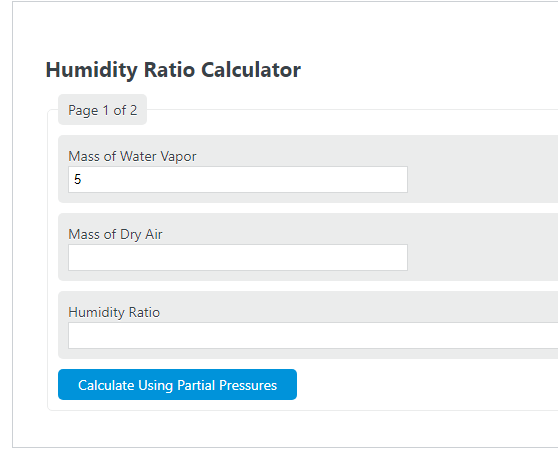
Calculate humidity ratio from dry-bulb temperature and relative humidity or dew point, with pressure or elevation correction and results in kg/kg, g/kg, lb/lb, and grains/lb.
- All Unit Converters
- Psychrometric Constant Calculator
- Specific Humidity Calculator
- Dehumidifier Capacity Calculator
Humidity Ratio Formula
Humidity ratio describes the mass of water vapor carried by a given mass of dry air. In psychrometrics, HVAC design, drying calculations, and air-conditioning analysis, it is one of the most useful moisture measurements because it is based on mass rather than on a temperature-dependent percentage.
When moisture content is found from air pressure conditions, the standard pressure-based form is:
Because this calculator uses temperature, relative humidity, and atmospheric pressure, the water vapor partial pressure is first determined from relative humidity and saturation vapor pressure at the entered temperature:
- w: humidity ratio, usually shown in kg/kg or g/kg of dry air
- mv: mass of water vapor
- mda: mass of dry air
- pv: partial pressure of water vapor
- P: total atmospheric pressure
- φ: relative humidity expressed as a decimal
- pws: saturation vapor pressure at the air temperature
How the Calculator Works
This calculator converts your three inputs into a dry-air moisture ratio:
- It uses the entered temperature to estimate the saturation vapor pressure of water in air.
- It applies the entered relative humidity to find the actual vapor partial pressure.
- It combines that vapor pressure with the entered atmospheric pressure to calculate humidity ratio on a dry-air basis.
| Input or Output | What It Represents |
|---|---|
| Temperature | Sets the moisture-carrying capacity of the air by changing the saturation vapor pressure. |
| Relative Humidity | Shows how close the air is to saturation at that temperature. |
| Atmospheric Pressure | Adjusts the dry-air basis of the calculation; lower pressure generally increases humidity ratio for the same vapor pressure. |
| Humidity Ratio | The mass of water vapor mixed with each unit mass of dry air. |
Why Humidity Ratio Is Useful
Relative humidity is helpful for comfort, but humidity ratio is often more useful for engineering and process work because it directly tracks how much water is actually in the air. That makes it valuable for:
- HVAC load calculations and psychrometric chart work
- Humidification and dehumidification sizing
- Drying ovens, kilns, and process air systems
- Compressed air and ventilation analysis
- Greenhouse, storage, and indoor air control
- Comparing moisture content at different elevations or barometric pressures
Example Calculation
Suppose the air conditions are 25°C, 50% relative humidity, and 101.325 kPa atmospheric pressure. At 25°C, the saturation vapor pressure is about 3.17 kPa, so the actual vapor pressure is:
Now substitute that value into the humidity ratio equation:
This means each kilogram of dry air contains about 9.88 grams of water vapor.
Humidity Ratio vs. Related Moisture Terms
| Term | Meaning | Best Used For |
|---|---|---|
| Humidity Ratio | Mass of water vapor per mass of dry air | HVAC design, psychrometrics, dehumidification, process air |
| Relative Humidity | How close the air is to saturation at a given temperature | Comfort, condensation risk, weather reporting |
| Specific Humidity | Mass of water vapor per mass of total moist air | Meteorology and atmospheric analysis |
| Dew Point | The temperature at which condensation begins for the current moisture content | Condensation control and moisture diagnostics |
Important Notes for Accurate Results
- Use absolute atmospheric pressure. Barometric pressure affects the result, especially at higher elevations.
- Do not confuse relative humidity with humidity ratio. A value like 50% relative humidity does not mean the humidity ratio is 0.50.
- Warmer air can hold much more moisture. Two air samples with the same relative humidity can have very different humidity ratios if their temperatures are different.
- Check your output units. kg/kg is the base engineering unit, while g/kg is often easier to read in building and comfort applications.
Practical Interpretation
A rising humidity ratio means more actual moisture is being added to the air. If air is heated without adding or removing moisture, the humidity ratio stays essentially the same while the relative humidity changes. If moisture is removed by cooling and condensation or by dehumidification, the humidity ratio drops. That is why humidity ratio is one of the clearest ways to measure true moisture removal or moisture gain in an air stream.