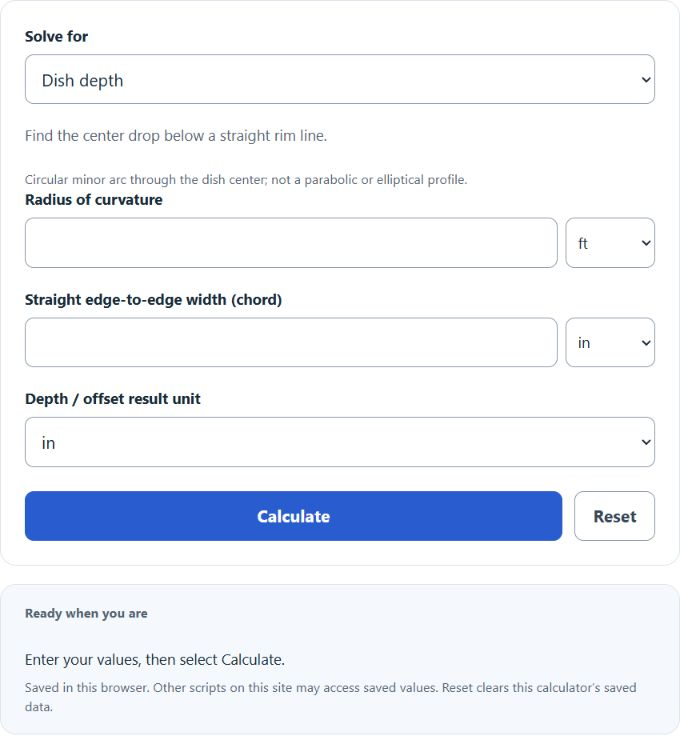
Calculate dish depth, radius, or rib offsets from width and sagitta for luthier guitar radius dishes with offset tables in ft, in, mm, cm, or m.
- All Math and Numbers Calculators
- Disc Volume Calculator
- Arc Height (Sagitta) Calculator
- Chord to Radius Calculator
- Arc Length Calculator
- Circle Volume Calculator
Dish Radius Formula
The calculator uses the standard chord-and-sagitta relationship of a circular arc. The depth mode solves for d from R and w; the radius mode solves for R from w and d. These modes use the minor circular arc, with 0 < w ≤ 2R and 0 < d ≤ w/2.
- R = radius of curvature of the dish
- w = chord width, measured straight across the dish or rib
- d = center depth, also called the sagitta, measured from a straight edge to the deepest point
- x = horizontal distance from the center of the rib
- offset(x) = how far below a straight rim line the curve sits at distance x
The three modes do this:
- Dish depth: You enter R and w, and the calculator returns d using the first formula. Use this when you have picked a target radius, like 25 ft, and want to know how deep the cut will be.
- Find radius: You enter w and d, and it returns R using the second formula. Use this to reverse-engineer an existing dish or template.
- Rib offsets: You enter R, w, and a mark spacing. It returns the maximum center offset and a table of offsets at each spacing increment, using the offset(x) formula. Use this to mark cut lines on a curved support rib.
Common Dish Radii and Depths
The first table shows typical luthier radius dishes and the resulting center depth on a 24 in wide blank. The second table lists the chord-to-radius effect: for a fixed 25 ft radius, how depth changes with chord width.
| Radius | Common use | Depth at 24 in chord |
|---|---|---|
| 15 ft | Guitar back (pronounced) | 0.400 in |
| 20 ft | Guitar back (common) | 0.300 in |
| 25 ft | Guitar top (common) | 0.240 in |
| 28 ft | Guitar top (flatter) | 0.214 in |
| 40 ft | Classical or flat-top | 0.150 in |
| Chord width (R = 25 ft) | Center depth |
|---|---|
| 12 in | 0.060 in |
| 16 in | 0.107 in |
| 20 in | 0.167 in |
| 24 in | 0.240 in |
| 30 in | 0.375 in |
Worked Examples
Example 1: Find the depth of a 25 ft dish that is 24 in wide. Convert to inches: R = 300 in, w/2 = 12 in. Then d = 300 - sqrt(300² - 12²) = 300 - sqrt(89856) = 300 - 299.7599 = 0.2401 in. That matches the table above.
Example 2: You measured a used dish at 24 in across with a 0.30 in sag at the center. What radius is it? R = (12² + 0.30²) / (2 × 0.30) = (144 + 0.09) / 0.6 = 240.15 in, or about 20 ft.
FAQ
Does this work for both spherical dishes and cylindrical (radiused) ribs? Yes. The 2D math is identical. For a spherical dish, w is the straight chord through the center of the dish. For a cylindrical rib, w is the rib length and the offsets give you the cut profile.
Why does my calculated depth seem so small? Guitar radii are very large compared to the dish width, so the depth is genuinely small. A 28 ft radius across 24 in is only about 0.214 in deep. Use a depth gauge or feeler gauge, not a ruler, to verify.
Can I use this for arch-top instruments or speaker baffles? The formulas apply to a circular minor arc through the center of the dish or rib. Just match your input units and remember that this assumes a true circular curve, not a parabolic or elliptical one.
What if my radius is smaller than half the width? That geometry would mean the chord is longer than the diameter, which is impossible. The calculator flags this and asks you to recheck the inputs.