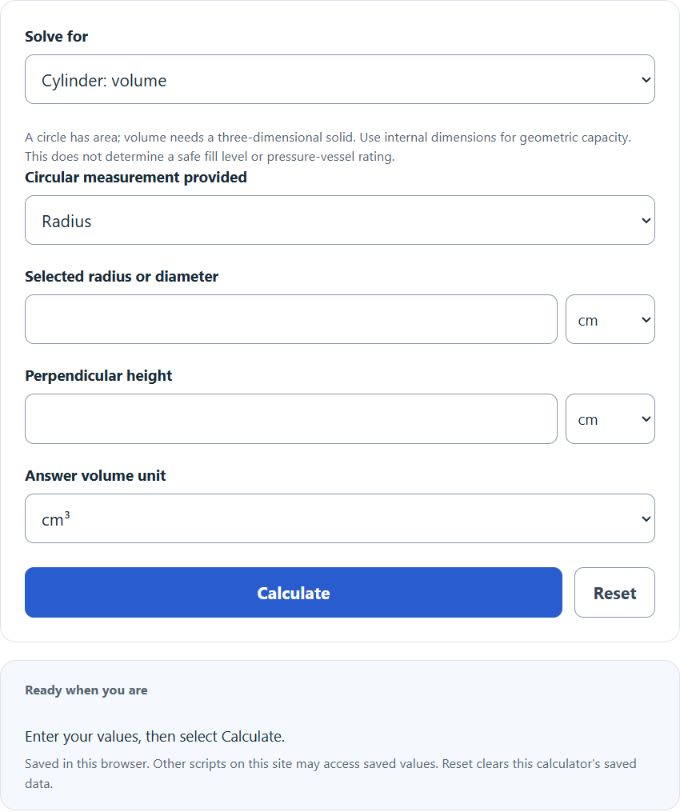
Calculate cylinder, cone, or sphere volume—or solve for radius, diameter, or height—with metric and imperial cubic units, liters, and US gallons.
- All Math and Numbers Calculators
- All Volume Calculators
- Aquarium Volume Calculator
- Circle Length Calculator
- Cylinder Capacity Calculator
- Pipe Volume Calculator
- Volume in Terms of Pi Calculator
Volume Formulas for Circular Solids
Three fundamental three-dimensional shapes share a circular cross-section: the cylinder, the cone, and the sphere. Their volume formulas all derive from the area of a circle (A = pi * r^2) extended into a third dimension.
Cylinder Volume
A cylinder’s volume equals the base circle area multiplied by its height. Every horizontal cross-section through a cylinder is identical to its base, which is why the formula involves no fractional coefficient.
Cone Volume
A cone occupies exactly one-third of a cylinder with the same base and height. This 1/3 factor arises because the cone tapers linearly from full radius at the base to zero at the apex, and integrating circular cross-sections of decreasing radius across the height yields one-third of the full cylinder volume.
Sphere Volume
A sphere’s volume depends only on its radius. When placed inside a cylinder of equal radius and height equal to the sphere’s diameter (2r), the sphere occupies exactly two-thirds of that cylinder’s volume. This relationship was first proven by Archimedes around 225 BCE in his treatise “On the Sphere and Cylinder,” a result he considered his greatest achievement. A diagram of a sphere inscribed in a cylinder was reportedly engraved on his tomb at his request.
The Archimedes Ratio: Cone, Sphere, and Cylinder
When a cone, a sphere, and a cylinder share the same radius r and the cylinder and cone both have height h = 2r, their volumes fall in the exact ratio 1 : 2 : 3. This means a cone of that size holds one unit of volume, the sphere holds two, and the cylinder holds three. In practical terms, it takes exactly three cones of water to fill the cylinder, and the sphere fills two-thirds of it. Archimedes proved this by imagining each solid sliced into infinitely thin circular discs and comparing their areas at every height, a technique that anticipated integral calculus by nearly two millennia.
Volume Conversion Reference
Converting between volume units is essential when applying these formulas in engineering, manufacturing, and everyday use. The table below provides key conversions.
| From | To | Multiply by |
|---|---|---|
| 1 cubic inch (in^3) | cubic centimeters (cm^3) | 16.387 |
| 1 cubic foot (ft^3) | cubic inches (in^3) | 1,728 |
| 1 cubic foot (ft^3) | US gallons | 7.481 |
| 1 cubic meter (m^3) | liters | 1,000 |
| 1 cubic meter (m^3) | US gallons | 264.172 |
| 1 liter | cubic inches (in^3) | 61.024 |
| 1 US gallon | liters | 3.785 |
| 1 US gallon | cubic inches (in^3) | 231 |
Illustrative Cylinder Volumes
The table below evaluates ideal cylinders using the listed diameter and height. These are geometric examples, not rated container capacities. Real cans, glasses, drums, heaters and pressure vessels have walls, non-cylindrical features and usable-fill limits.
| Container | Approx. Diameter | Approx. Height | Volume |
|---|---|---|---|
| Example cylinder A | 2.6 in (6.6 cm) | 4.83 in (12.3 cm) | 25.64 in^3 (0.420 L) |
| Example cylinder B | 3.5 in (8.9 cm) | 5.8 in (14.7 cm) | 55.80 in^3 (0.914 L) |
| Example cylinder C | 22.5 in (57.2 cm) | 33.5 in (85.1 cm) | 13,319.86 in^3 (218.273 L) |
| Example cylinder D | 20 in (50.8 cm) | 46 in (116.8 cm) | 14,451.33 in^3 (236.815 L) |
| Example cylinder E | 12.5 in (31.8 cm) | 18 in (45.7 cm) | 2,208.93 in^3 (36.198 L) |
Industry Applications of Circular Volume Calculations
Oil and gas storage: Cylindrical tanks are the standard for storing crude oil, refined fuels, and liquefied natural gas. Geometry estimates enclosed volume; it cannot determine safe fill limits or prevent overpressure. Use the vessel’s rating and applicable operating requirements. A typical above-ground petroleum storage tank with a 30 ft diameter and 40 ft height holds approximately 28,274 ft^3, or roughly 211,500 US gallons.
Water and wastewater treatment: Municipal water towers, clarifier basins, and digesters are all cylindrical. Volume calculations determine holding capacity, retention time, and chemical dosing rates. A municipal water tower with a spherical tank 40 ft in diameter holds approximately 33,510 ft^3, or about 250,700 gallons.
Concrete and construction: Cylindrical forms are used for columns, piers, and sonotubes. A 12-inch diameter sonotube that is 4 ft tall requires approximately 3.14 ft^3 (0.089 m^3) of concrete, At an approximate yield of 0.60 ft^3 per 80 lb bag of QUIKRETE Concrete Mix, that is 3.14/0.60 ≈ 5.24 bags, rounded up to 6 before any additional waste allowance. Check the actual product yield.
Packaging and food science: The cylinder is the most common shape for cans and bottles due to its structural efficiency. Material use depends on proportions, wall and end construction, strength and manufacturing requirements. Equal volume alone does not establish that every cylinder uses less surface area than every rectangular box.
Pharmaceutical and laboratory: Conical flasks (Erlenmeyer) and spherical flasks (round-bottom) are standard laboratory glassware. Geometric formulas provide estimates; accurate laboratory volumes require calibrated apparatus and an appropriate measurement method. NIST volumetric calibration procedures include gravimetric and volume-transfer methods.
Geometric Efficiency: Why Circles Dominate Volume
Among all closed curves of a given perimeter, the circle encloses the maximum area. This property, known as the isoperimetric inequality, extends into three dimensions: the sphere encloses the maximum volume for a given surface area. For any fixed amount of material (surface area), a sphere will hold more contents than any other shape. This is why soap bubbles form spheres, why planets are roughly spherical under gravity, and why pressurized gas tanks are often spherical or have hemispherical end caps.
For a cylinder, the optimal proportions that maximize volume for a given surface area occur when the height equals the diameter (h = 2r). At this ratio, the cylinder uses its material most efficiently. This optimum assumes a closed ideal cylinder and uniform surface cost. Manufacturing, handling and end construction can favor other proportions.
Calculator Change Log:
- 6/10/25 – Added functionality and clarity for calculating cylinder, sphere, and cone volumes. These are three-dimensional solids with circular sections; a two-dimensional circle itself has no volume.