Calculate the distance from a point to a plane using A, B, C, D and coordinates X, Y, Z, with the result shown as a decimal distance.
- All Math and Numbers Calculators
- All Distance Calculators
- Distance Between Points Calculator
- Midpoint Calculator
- Arc Length Calculator
Distance From Point to Plane Formula
The distance from a point to a plane is the shortest straight-line distance from the point to any location on the plane. For a plane written in standard form:
and a point:
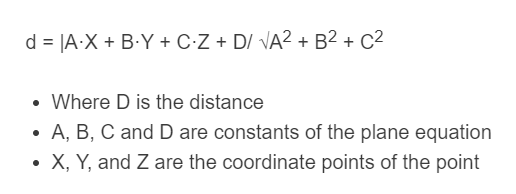
the distance is:
- A, B, C: coefficients of the plane equation
- D: constant term in the plane equation
- X, Y, Z: coordinates of the point
- | |: absolute value, which makes the distance nonnegative
- sqrt(A^2 + B^2 + C^2): length of the plane’s normal vector
The calculator substitutes the point coordinates into the plane equation, takes the absolute value of that result, then divides by the length of the normal vector. The coefficients A, B, and C cannot all be zero because that would not define a valid plane.
Plane Equation Inputs and Meaning
| Input | What it represents | Example |
|---|---|---|
| A | Coefficient of x in the plane equation | For 2x + 3y – z + 6 = 0, A = 2 |
| B | Coefficient of y in the plane equation | For 2x + 3y – z + 6 = 0, B = 3 |
| C | Coefficient of z in the plane equation | For 2x + 3y – z + 6 = 0, C = -1 |
| D | Constant term in the plane equation | For 2x + 3y – z + 6 = 0, D = 6 |
| X, Y, Z | Coordinates of the point | For point (4, -2, 5), X = 4, Y = -2, Z = 5 |
Common Distance Result Checks
| Result | Meaning |
|---|---|
| 0 | The point lies on the plane. |
| Positive number | The point is not on the plane. The value is the shortest distance to the plane. |
| Undefined denominator | A, B, and C are all 0, so the equation does not define a plane. |
Example Problems
Example 1
Find the distance from the point (1, 2, 3) to the plane 2x – y + 2z – 5 = 0.
The distance is 0.3333.
Example 2
Find the distance from the point (3, -1, 2) to the plane x + 2y – 2z + 4 = 0.
The distance is 0.3333.
FAQ
What form does the plane equation need to be in?
The calculator uses the standard plane form Ax + By + Cz + D = 0. If your equation is written another way, rearrange it so all terms are on one side and the other side is 0.
Why is there an absolute value in the formula?
The expression A*X + B*Y + C*Z + D can be positive, negative, or zero depending on which side of the plane the point is on. Distance cannot be negative, so the formula uses the absolute value.
What does it mean if the distance is 0?
A distance of 0 means the point is exactly on the plane. When you substitute X, Y, and Z into Ax + By + Cz + D, the result is 0.