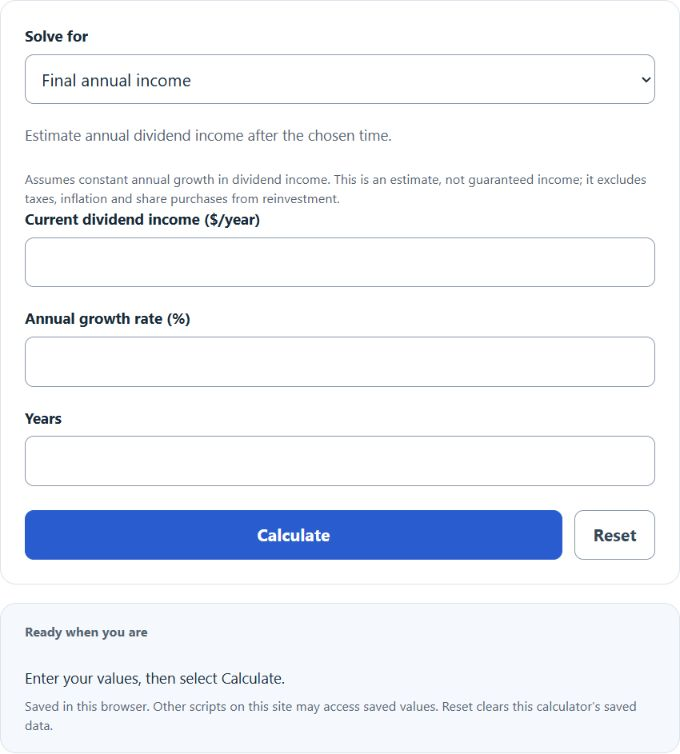
Calculate constant compound dividend-income growth by explicitly selecting current income, annual growth rate, elapsed years or final annual income.
Dividend Growth Formula
The dividend growth calculator uses compound growth. Choose the value to solve and enter the three displayed inputs. Current and final income are annual amounts; the model does not calculate cumulative dividends.
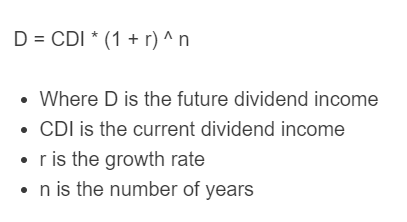
- FI = final dividend income
- CI = current dividend income
- g = underlying dividend growth rate, as a percent per year
- t = number of years
- ln = natural logarithm
The final income formula estimates future dividend income after compounding at a steady annual growth rate. The current income formula works backward from a future dividend income target. The growth rate formula finds the annual growth rate needed to move from current income to final income over a set number of years. The years formula finds how long it takes for dividend income to reach a target at a given growth rate.
Dividend Growth Rate Reference
Dividend growth rates vary by company, sector, payout ratio, and business cycle. The table below shows the one-year multiplier implied by illustrative constant annual growth rates; these are not market benchmarks.
| Annual dividend growth rate | One-year income multiplier |
|---|---|
| 0% | 1.00 × current annual income. |
| 1% to 3% | 1.01 to 1.03 × current annual income. |
| 4% to 7% | 1.04 to 1.07 × current annual income. |
| 8% to 12% | 1.08 to 1.12 × current annual income. |
| Above 12% | More than 1.12 × current annual income. |
Time Needed to Double Dividend Income
This table shows about how long it takes for dividend income to double at different annual growth rates, assuming the rate stays constant.
| Annual growth rate | Approximate years to double |
|---|---|
| 3% | 23.45 years |
| 5% | 14.21 years |
| 7% | 10.24 years |
| 10% | 7.27 years |
Example Calculations
Example 1: Calculate final dividend income
You currently receive $2,000 per year in dividend income. You expect dividend income to grow by 6% per year for 10 years.
The estimated final dividend income is $3,581.70.
Example 2: Calculate the required dividend growth rate
You currently receive $1,500 per year in dividend income and want it to reach $3,000 in 12 years.
The required annual dividend growth rate is 5.95%.
FAQ
Does this calculator include reinvested dividends?
No. This calculator estimates dividend income growth from an underlying growth rate. It does not add extra shares from dividend reinvestment unless your growth rate already reflects the effect of reinvestment.
Is dividend growth the same as stock price growth?
No. Dividend growth measures how dividend income changes over time. Stock price growth measures how the market value of the shares changes. A stock can have growing dividends while its share price rises, falls, or stays flat.
Can the dividend growth rate be negative?
Yes, rates between −100% and 0% represent shrinking income. Years must be nonnegative. Solving a growth rate requires positive endpoints and positive years; solving years requires positive endpoints and nonzero growth. A target in the opposite growth direction has no nonnegative elapsed-time solution.