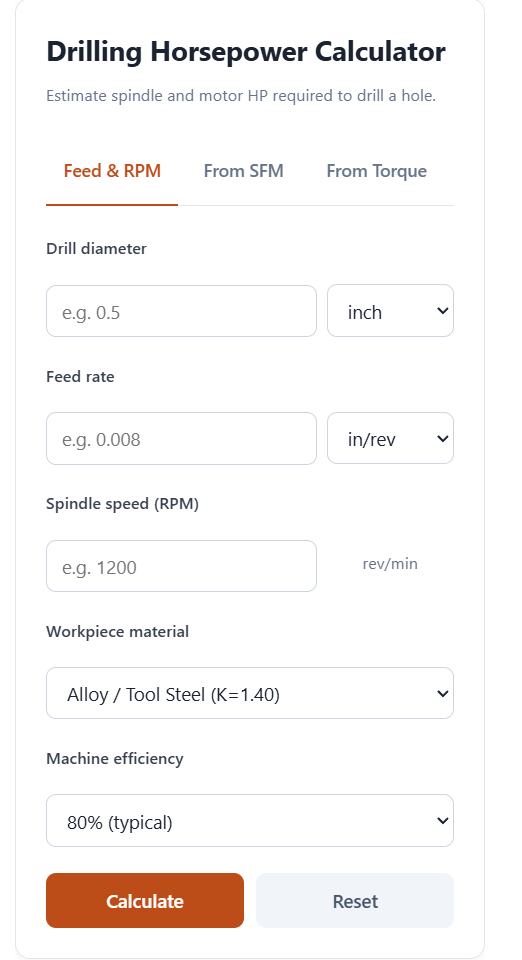
Enter the drill diameter, feed rate, and spindle speed — or use the SFM or torque modes — to estimate the cutting and motor horsepower required to drill a hole in a given material.
Related Calculators
- All Automotive Calculators
- Spindle Horsepower Calculator
- Tapping Horsepower Calculator
- Corrected Horsepower Calculator
Formula
Feed & RPM mode:
MRR = (π / 4) × D2 × fm
HPc = K × MRR
HPm = HPc / η
where D = drill diameter (in), fm = feed rate (in/min), K = unit power factor (HP per in³/min), η = machine efficiency.
From SFM:
RPM = (SFM × 12) / (π × D), then apply the formula above with fm = IPR × RPM.
From Torque:
HPc = (T × RPM) / 5252
HPm = HPc / η
where T = spindle torque (lb·ft), RPM = spindle speed, η = efficiency.
Interpretation
The headline value is the motor horsepower needed at the input — the power the machine must deliver after drivetrain losses. The cutting horsepower shown below it is the actual work being done at the tool tip. Compare the motor value to your drill’s rated spindle power to decide whether the cut is feasible.
- Under 1 HP: Light-duty; benchtop and hand drills handle it.
- 1–3 HP: Typical floor-model drill press range.
- 3–7.5 HP: Mid-size industrial drill or CNC machining center.
- 7.5–20 HP: Radial arm drills and large CNC spindles.
- Over 20 HP: Heavy industrial; verify spindle torque limits, not just HP.
If the result is close to your machine’s rating, reduce feed per revolution first — HP scales linearly with feed but quadratically with diameter.
Typical K Factors (Unit Power)
| Material | K (HP·min/in³) |
|---|---|
| Plastic / nylon | 0.15 |
| Aluminum | 0.25 |
| Brass / bronze | 0.50 |
| Cast iron | 0.75 |
| Mild / carbon steel | 1.00 |
| Titanium | 1.30 |
| Stainless steel | 1.35 |
| Alloy / tool steel | 1.40 |
| Hardened steel | 2.00 |
Values assume a sharp drill. Add 25–50% for dull tooling or inadequate coolant.
FAQ
What units do I use for feed rate?
The calculator accepts either in/rev (IPR) or in/min (IPM). If you only know IPR, enter it along with RPM and the tool converts to IPM internally.
Why is motor HP higher than cutting HP?
Cutting HP is the power consumed at the drill tip. Motor HP is what the motor must supply to produce that cutting power after belt, gear, and bearing losses — it equals cutting HP divided by efficiency (typically 0.75–0.90).
Does drill diameter or feed affect power more?
Diameter. Cutting HP scales with D2 because it drives the chip area, while feed rate scales linearly. Doubling the drill diameter roughly quadruples the required HP at the same feed per revolution.
When should I use the torque mode?
Use it when you have a measured or spec-sheet spindle torque value and want to convert directly to HP. It bypasses the material factor and is useful for sizing a motor against a known torque requirement.