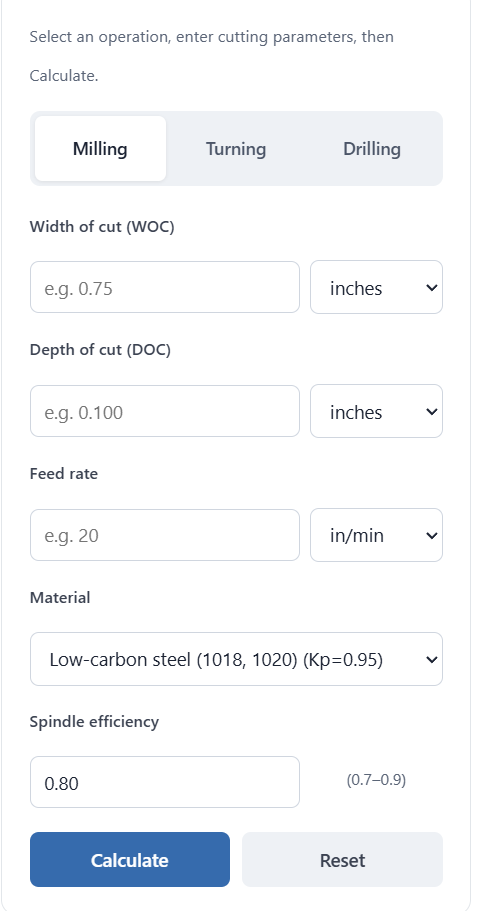
Enter your cutting parameters — width and depth of cut, feed rate, workpiece material, and spindle efficiency — to estimate the horsepower required at the spindle for milling, turning, or drilling.
Related Calculators
- All Automotive Calculators
- Drilling Horsepower Calculator
- Tapping Horsepower Calculator
- V-Belt Horsepower Calculator
Formula
Spindle horsepower is derived from the material removal rate (MRR), a unit power factor (Kp), and machine efficiency (η).
Milling: MRR = WOC × DOC × F
Turning: MRR = 12 × Vc × fr × DOC
Drilling: MRR = (π/4) × D² × fr × N
HPspindle = (MRR × Kp) / η
where WOC = width of cut (in), DOC = depth of cut (in), F = feed rate (in/min), Vc = cutting speed (SFM), fr = feed per revolution (in/rev), D = tool diameter (in), N = spindle speed (RPM), Kp = unit power (HP·min/in³), and η = spindle efficiency.
Interpretation
The result is the horsepower the spindle motor must deliver to sustain the cut you specified. Your machine needs a rated spindle power at or above this value, with some margin for tool wear and feed-rate spikes. Use these bands as a quick sanity check:
- Under 3 HP — light load; typical for hobby mills, benchtop lathes, and small drills.
- 3–10 HP — moderate load; mid-size CNC milling and turning centers.
- Over 10 HP — heavy load; production machinery or roughing in tough alloys.
If the required HP exceeds your machine’s rating, reduce DOC, WOC, or feed — cutting DOC by half roughly halves the power draw because MRR scales linearly with each input.
Unit Power (Kp) Reference
Kp is the horsepower needed per cubic inch of material removed per minute at 100% efficiency. It varies by workpiece hardness.
| Material | Kp (HP·min/in³) |
|---|---|
| Plastics | 0.10 |
| Aluminum alloys | 0.25 |
| Cast iron (soft) | 0.50 |
| Brass / soft bronze | 0.55 |
| Low-carbon steel (1018, 1020) | 0.95 |
| Medium-carbon steel (1045) | 1.15 |
| Titanium alloys | 1.30 |
| Stainless steel (304, 316) | 1.35 |
| Alloy steel (4140, 4340) | 1.40 |
| Inconel / nickel alloys | 2.00 |
FAQ
What efficiency value should I use?
Use 0.80 for most direct-drive and belt-drive milling or turning spindles. Drop to 0.75 for drilling or older gear-driven machines, and use 0.90 for modern high-efficiency direct-drive spindles.
Why is my calculated HP higher than my chip-load tables suggest?
Kp values assume sharp tooling and reasonable chip thickness. Dull tools, very thin chips, or rubbing cuts can multiply actual power draw by 1.3–1.5×. If you’re running worn tooling, add that margin on top of the result.
Can I mix metric and imperial inputs?
Yes. Each field has its own unit selector and converts internally to inches before computing MRR. Just pick the unit that matches what you typed.
Is spindle horsepower the same as motor horsepower?
Not exactly. The calculator reports the power the motor must supply to produce the required cutting power at the tool, accounting for drivetrain losses through η. The motor’s nameplate rating should meet or exceed this value.