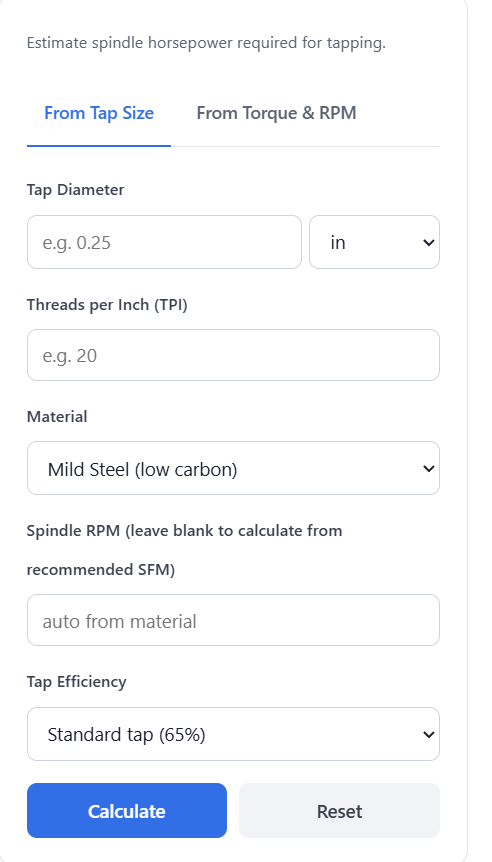
Enter the tap diameter, threads per inch, and workpiece material — or plug in torque and RPM directly — to estimate the spindle horsepower needed to drive a tap through the hole.
Related Calculators
- All Automotive Calculators
- Drilling Horsepower Calculator
- Spindle Horsepower Calculator
- V-Belt Horsepower Calculator
Formula
Tapping horsepower is derived from cutting torque and spindle speed:
HP = (T × N) / 63,025
where T = tapping torque (in·lb), N = spindle speed (RPM)
When torque is not measured, it is estimated from the tap geometry and material:
T ≈ (32 × K × D² × TPI) / η
where K = material factor, D = tap diameter (in), TPI = threads per inch, η = tap efficiency
Spindle RPM from surface speed:
N = (SFM × 3.82) / D
where SFM = surface feet per minute for the material, D = tap diameter (in)
Interpretation
The result is the spindle power the cut actually consumes at the tap. Your machine’s motor must exceed this by a margin, since drive losses and the rigid reversal cycle in tapping add overhead. Use these ranges as a rough guide:
- Under 0.5 HP — light load; benchtop drill presses and small CNCs handle it.
- 0.5–2 HP — typical for small mills tapping steel up to about 1/4″–3/8″.
- 2–5 HP — larger taps or harder alloys; needs a capable knee mill or VMC.
- Above 5 HP — industrial spindle territory, common for taps over 3/4″ in steel.
If the required HP is close to your machine’s rating, drop to a form tap, use a spiral-flute tap for better chip evacuation, or break the thread into a pre-threaded pilot.
Typical Material Factors and Surface Speeds
| Material | K factor | SFM (HSS tap) |
|---|---|---|
| Aluminum | 0.3 | 100 |
| Brass / Bronze | 0.5 | 70 |
| Cast Iron | 0.7 | 70 |
| Mild Steel | 1.0 | 40 |
| Medium Carbon Steel | 1.3 | 30 |
| Stainless Steel | 1.5 | 20 |
| Tool / Alloy Steel | 1.7 | 15 |
| Titanium | 1.6 | 15 |
FAQ
What units should I use for diameter?
Either inches or millimeters — use the unit selector next to the diameter field. The calculator converts mm to inches internally because the horsepower constant (63,025) assumes in·lb torque and RPM.
Why is tapping torque so much higher than drilling torque for the same hole?
A tap engages the full thread profile along the full length of engagement at once, so it removes more material per revolution than a drill and adds friction on the thread flanks. Expect tapping torque to run several times higher than drilling torque in the same diameter.
Should I use the calculated HP as my motor size?
No. Size the motor above the calculated value to account for drive losses, a dull or worn tap, and the peak load on reversal. A 1.5–2× safety factor is common for production tapping.
What if I only have metric thread pitch instead of TPI?
Convert with TPI = 25.4 / pitch(mm). A 1.5 mm pitch equals about 16.9 TPI. Enter that value along with the tap diameter.