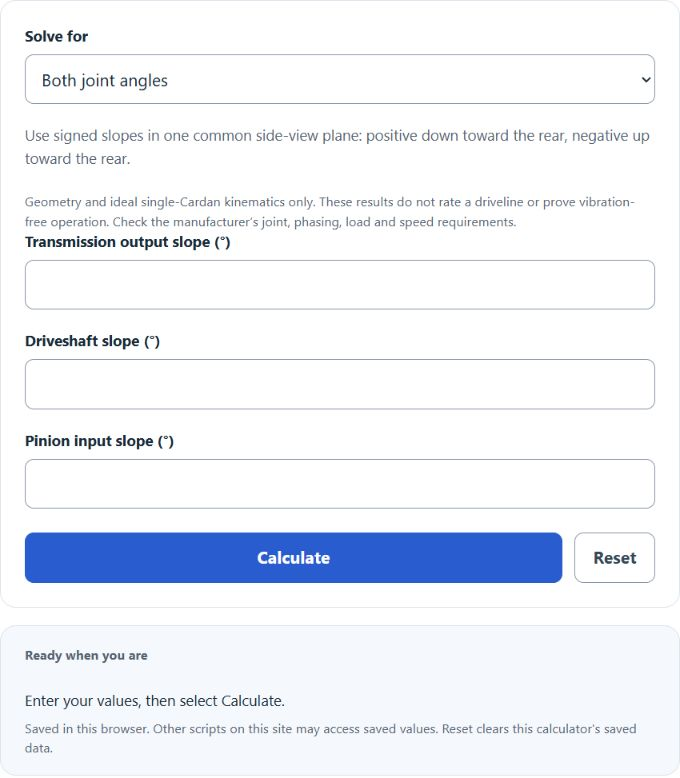
Calculate the operating angle at each driveshaft U-joint from your transmission, driveshaft, and pinion slopes, and check balance, speed change, and RPM limits.
Driveshaft U-Joint Operating Angle Formula
A U-joint operating angle is the angle between the two shafts that meet at that joint. On a driveshaft you have two of them, one at the transmission and one at the pinion. The calculator finds each one from the slope of the parts, measured with an angle gauge:
Front angle = | Transmission slope - Driveshaft slope |
 Rear angle = | Driveshaft slope - Pinion slope |
Slopes that tilt the same way subtract, and slopes that tilt opposite ways add. When you know a single operating angle and the shaft speed, the tool also finds how much the joint makes the output shaft speed up and slow down each turn:
Peak output = Input RPM / cos(A)
 Low output = Input RPM * cos(A)
 Increase above input = (1 / cos(A) - 1) * 100 %
 Decrease below input = (1 - cos(A)) * 100 %
For one shaft whose vertical and horizontal projections are measured relative to the same aligned reference axis, the exact compound angle combines the tangents. This does not combine arbitrary angle differences between two independently tilted shafts. The retained root-sum-square option is a small-angle approximation, limited here to a combined estimate of 15 degrees:
Projection model: angle = atan(sqrt(tan(Vertical)^2 + tan(Horizontal)^2))
 Small-angle approximation = sqrt(Vertical^2 + Horizontal^2)
Variables:
- Transmission slope is the tilt of the transmission output shaft, in degrees
- Driveshaft slope is the tilt of the driveshaft itself, in degrees
- Pinion slope is the tilt of the axle input (pinion) shaft, in degrees
- Front angle and Rear angle are the operating angles at the transmission and pinion joints
- A is a single U-joint operating angle, in degrees
- Input RPM is the constant speed of the shaft driving a single Cardan joint; Vertical and Horizontal are orthogonal projections of one shaft relative to a common reference axis
The first two modes use signed coplanar slopes: positive down toward the rear, negative up toward the rear. Their differences give geometric joint angles below 90 degrees. The speed mode returns ideal single-Cardan speed extrema and the Spicer reference table only within its published 1500–5000 RPM interval; intermediate values are labelled linear interpolation. The compound mode uses the specified common-axis projection model or a retained small-angle approximation. No mode certifies a driveline or proves vibration-free operation.
Maximum Operating Angle by Driveshaft RPM
Spicer publishes these general maximum operating-angle references. Joint-series limits, torque, duty, geometry and other manufacturer restrictions still apply. An angle below 3 degrees is not an assurance of safe or vibration-free operation. This calculator uses the table only from 1500 to 5000 RPM and labels interpolation between rows; it does not extrapolate or clamp speeds outside that interval.
| Driveshaft RPM | Max operating angle |
|---|---|
| 5000 | 3.2 deg |
| 4500 | 3.7 deg |
| 4000 | 4.2 deg |
| 3500 | 5.0 deg |
| 3000 | 5.8 deg |
| 2500 | 7.0 deg |
| 2000 | 8.7 deg |
| 1500 | 11.5 deg |
Tandem and interaxle applications can require different limits; consult their specific manufacturer guidance. The next table shows ideal single-joint percentage increase and decrease relative to constant input speed, plus the peak-to-peak swing at 3000 RPM. The two percentage excursions are not exactly symmetric.
| Operating angle | Increase / decrease | Peak-to-peak at 3000 RPM |
|---|---|---|
| 1 deg | +0.0152% / −0.0152% | 0.9139 RPM |
| 2 deg | +0.0610% / −0.0609% | 3.6562 RPM |
| 3 deg | +0.1372% / −0.1370% | 8.2284 RPM |
| 5 deg | +0.3820% / −0.3805% | 22.8754 RPM |
| 7 deg | +0.7510% / −0.7454% | 44.8910 RPM |
| 10 deg | +1.5427% / −1.5192% | 91.8566 RPM |
| 15 deg | +3.5276% / −3.4074% | 208.0511 RPM |
The ideal variation occurs twice per turn for a nonzero single-Cardan angle with constant input speed. A correctly phased two-joint arrangement with the required matching geometry can cancel output velocity variation, while the intermediate shaft still varies. Equal angle magnitudes alone do not prove correct phasing, geometry or vibration-free operation.
Example Problems
Example 1: find both operating angles. Your transmission output points down 3 degrees at the rear, the driveshaft points down 5.5 degrees, and the pinion shaft points down 3 degrees. The front joint is the difference between the transmission and driveshaft slopes, and the rear joint is the difference between the driveshaft and pinion slopes:
Front angle = | 3 - 5.5 | = 2.5 degrees, and Rear angle = | 5.5 - 3 | = 2.5 degrees. The angles are equal and within the general 1 to 3 degree range; correct phasing, full spatial geometry and manufacturer requirements still need verification.
Example 2: a single joint has a 4-degree angle and 3500 constant input RPM. The modeled peak is 3500/cos(4°) ≈ 3508.5466 RPM and minimum is 3500×cos(4°) ≈ 3491.4742 RPM. Peak-to-peak variation is 17.0725 RPM; excursions are +0.244190% and −0.243595%. The Spicer table lists 5.0 degrees at 3500 RPM as a general reference, subject to the application’s more restrictive limits.
Frequently Asked Questions
What is a good U-joint operating angle?
Aim for 1 to 3 degrees at each joint, with the two joints on a shaft equal within 1 degree (within half a degree for motor homes and shafts ahead of a transfer case). Keep every joint at half a degree or more so the needle bearings keep rotating, and stay at 3 degrees or less for the smoothest running.
Why do the two U-joint angles have to be equal?
A single U-joint makes the shaft it drives speed up and slow down twice per turn. If the joint at the other end of the driveshaft runs the same angle and is phased correctly, its speed change is exactly opposite and the two cancel, so the axle turns at a steady speed. If the angles are not equal, part of that speed change is left over and shows up as a torsional vibration that gets worse with engine speed.
Can a U-joint operating angle be too small?
Yes. A joint running at or near zero degrees barely moves its needle bearings, so the rollers press on the same spot and brinell small dents into the bearing cups, which then wear and get noisy. That is why the minimum is about half a degree to one degree. You want the angle small, but not zero.