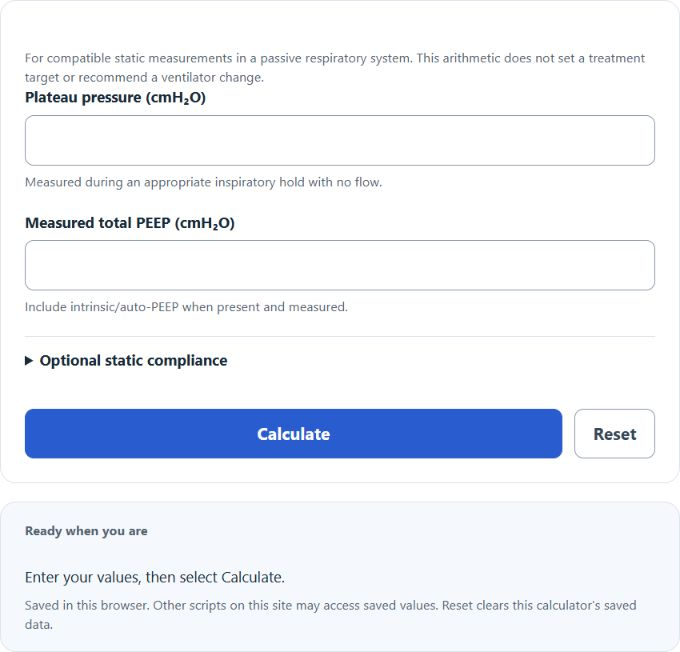
Calculate ventilator driving pressure from plateau pressure and measured total PEEP, with optional static respiratory-system compliance. The result does not set a treatment target.
Driving Pressure Formula
Ventilator driving pressure is the difference between plateau pressure and total positive end-expiratory pressure under appropriate static measurement conditions:
Driving pressure (ΔP) = Pplat − PEEPtot
Static respiratory-system compliance (Crs) = VT ÷ ΔP
Pressure is expressed in centimeters of water, written cmH₂O. When tidal volume is supplied in milliliters, compliance is expressed in mL/cmH₂O. This calculator does not use pascals, does not calculate mechanical power, and does not classify the result into low, target, or high bands.
Variables and Units
| Variable | Meaning | Unit |
|---|---|---|
| Pplat | Plateau pressure measured during an appropriate inspiratory hold and no-flow condition | cmH₂O |
| PEEPtot | Total PEEP, including intrinsic or auto-PEEP when it is present and measured | cmH₂O |
| ΔP | Respiratory-system driving pressure | cmH₂O |
| VT | Corresponding tidal volume, preferably exhaled volume from the same conditions | mL or L |
| Crs | Static compliance of the respiratory system | mL/cmH₂O |
Pplat must be greater than zero. Total PEEP may be zero, but it cannot be negative. Pplat must also be greater than PEEPtot; equality or a lower plateau value makes this simple calculation invalid or inapplicable. If tidal volume is entered, it must be greater than zero and should correspond to the same breath and ventilator conditions.
What Is Driving Pressure?
In a passive, mechanically ventilated respiratory system, driving pressure represents the pressure change used to deliver the tidal volume above the pressure remaining at end expiration. The calculation is simple, but the measurement is not merely a subtraction of any two numbers visible on a ventilator screen. Pplat and PEEPtot need compatible, static conditions for the result to carry the intended physiologic meaning.
Driving pressure describes the respiratory system as a whole. The value reflects lung and chest-wall mechanics together. It is not automatically equal to transpulmonary pressure, which attempts to separate the pressure across the lung from the pressure used to move the chest wall. Changes in body position, chest-wall stiffness, abdominal pressure, recruitment, effort, or ventilator interaction can change what the same ΔP means clinically.
How Plateau Pressure and Total PEEP Are Measured
Plateau pressure is generally assessed during an end-inspiratory hold when flow has stopped. The pause allows airway pressure to approach an equilibrated static pressure. The measurement assumes that the patient is not adding substantial inspiratory or expiratory muscle pressure. Spontaneous effort, coughing, dyssynchrony, a short or poorly executed hold, leaks, or changing flow can make the displayed plateau pressure unsuitable for this equation.
Total PEEP is the pressure remaining at end expiration. It includes set or external PEEP and any intrinsic PEEP caused by incomplete exhalation. Intrinsic PEEP may be assessed with an expiratory hold when the clinical and ventilator conditions permit. If intrinsic PEEP is present but only set PEEP is subtracted, driving pressure can be overstated. Conversely, an unreliable expiratory hold can give a misleading PEEPtot. A trained clinician must establish whether the measurements are technically valid.
How to Use the Driving Pressure Calculator
- Confirm that Pplat was measured in cmH₂O during an appropriate inspiratory hold with no meaningful flow and acceptable patient-ventilator conditions.
- Enter total PEEP in cmH₂O. Do not automatically substitute set PEEP when intrinsic PEEP is relevant.
- Optionally enter the corresponding tidal volume and select mL or L. The calculator converts liters to milliliters for compliance.
- Calculate ΔP. If tidal volume is present, review the separately calculated Crs.
- Interpret the number with the measurement quality, ventilator settings, respiratory mechanics, effort, gas exchange, hemodynamics, and trend. Do not use the output as an automatic setting recommendation.
Worked Driving Pressure and Compliance Example
Assume Pplat is 26 cmH₂O and measured total PEEP is 10 cmH₂O. Driving pressure is 26 − 10 = 16 cmH₂O. If the corresponding tidal volume is 480 mL, static respiratory-system compliance is 480 ÷ 16 = 30 mL/cmH₂O.
If the entered tidal volume were 0.48 L, the calculator would first convert it to 480 mL and produce the same compliance. Mixing liters directly with milliliters would otherwise create a thousand-fold unit error. The example demonstrates arithmetic only; it does not label 16 cmH₂O as acceptable or unacceptable for a particular patient.
Evidence and the Often-Cited 15 cmH₂O Value
An influential individual-patient-data analysis by Amato and colleagues found that driving pressure was strongly associated with survival in acute respiratory distress syndrome and helped explain benefits associated with ventilator-setting changes in the analyzed trials. A value around 15 cmH₂O is therefore often discussed in ARDS literature and bedside education.
That association should not be converted into a universal target band. The analysis was not a public calculator rule, and a single measured value does not prove causation or determine an adjustment. Contemporary ARDS guidance defines driving pressure as plateau pressure minus total PEEP, but clinical decisions still integrate tidal volume, plateau pressure, PEEP, recruitability, oxygenation, mechanics, effort, hemodynamics, and response over time. This calculator intentionally reports the value without color-coded severity or treatment advice.
What Can Distort Driving Pressure?
- Spontaneous effort or dyssynchrony: patient-generated pressure can invalidate a passive static interpretation.
- Incomplete holds or residual flow: the displayed pressure may not represent a plateau or true total PEEP.
- Intrinsic PEEP: subtracting set PEEP instead of measured total PEEP changes ΔP.
- Leaks or circuit problems: pressure and volume may not represent the intended closed respiratory system.
- Chest-wall mechanics: obesity, abdominal pressure, edema, position, or other factors may alter respiratory-system pressure without an equivalent change in lung stress.
- Nonmatching data: combining Pplat, PEEPtot, and VT recorded at different times or settings undermines the compliance calculation.
Driving Pressure Compared with Other Ventilator Measures
Peak inspiratory pressure includes resistive pressure generated while gas is flowing; plateau pressure is measured during no flow and is used in the driving-pressure equation. PEEP is the end-expiratory baseline, while total PEEP includes intrinsic pressure. Transpulmonary pressure requires an estimate of pleural pressure, often using esophageal pressure, and cannot be calculated from Pplat and PEEP alone.
Mechanical power is also different. It attempts to describe energy transferred to the respiratory system per unit time and depends on more than ΔP, including respiratory rate and other pressure, volume, and flow components. Because this page does not collect a validated complete set of inputs for a specified mechanical-power equation, it does not estimate mechanical power.
Frequently Asked Questions
Should I enter set PEEP or total PEEP?
Enter total PEEP. When intrinsic PEEP is absent, total and set PEEP may be similar. When auto-PEEP is present, using set PEEP alone does not represent the formula specified here.
Does a higher result automatically require lower tidal volume or different PEEP?
No. The calculator does not recommend a ventilator change. Only trained clinicians with the full patient and ventilator context should adjust mechanical ventilation.
Is static compliance the same as lung compliance?
Not necessarily. Crs calculated from airway pressures describes the combined respiratory system, including lung and chest-wall contributions.
Primary and Current Sources