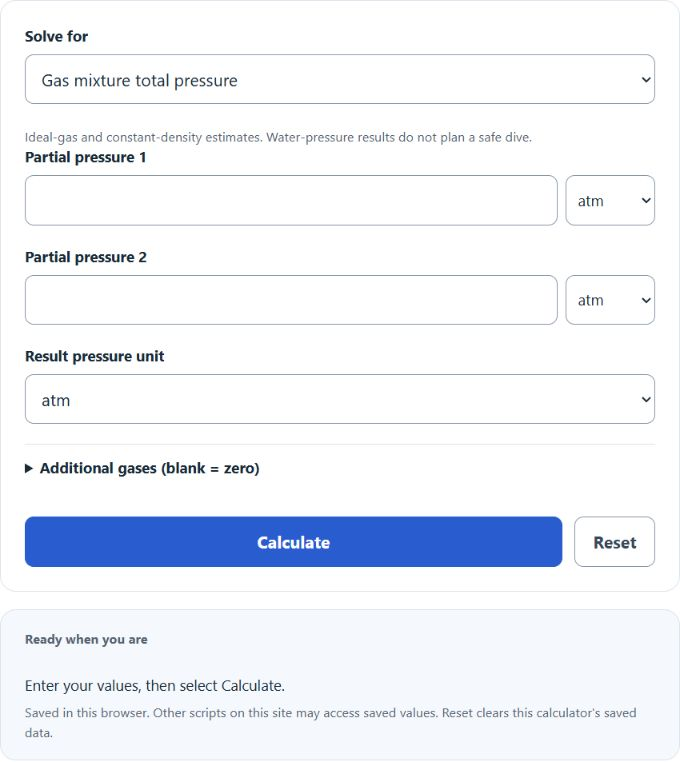
Calculate total pressure for gas mixtures, gauge pressure to absolute pressure, or diving depth from water column and atmospheric pressure.
- Partial Pressure Calculator
- Volume to Pressure Calculator
- Atmospheric Pressure Calculator
- Water Vapor Pressure Calculator
- Absolute Pressure Calculator
- Gauge Pressure Calculator
- All Physics Calculator
Total Pressure Formula
The term “total pressure” has two distinct meanings depending on context. In gas mixtures, total pressure is the sum of all partial pressures according to Dalton’s Law. In fluid dynamics, total pressure is the sum of static pressure and dynamic pressure according to Bernoulli’s principle.
Dalton’s Law (Gas Mixtures)
Each partial pressure can also be expressed using the mole fraction of the gas:
Where x_i is the mole fraction (moles of gas i divided by total moles in the mixture). This relationship means that if you know any two of the three values (partial pressure, mole fraction, total pressure), you can solve for the third.
Bernoulli’s Equation (Fluid Dynamics)
Here, P_static is the thermodynamic pressure of the fluid at rest, (1/2)pv^2 is the dynamic pressure from fluid motion, p is fluid density (kg/m^3), and v is flow velocity (m/s). This form applies to incompressible, inviscid flow along a streamline and is the basis of airspeed measurement in aviation using pitot tubes.
Partial Pressures of Earth’s Atmosphere at Sea Level
The most common real-world application of total pressure is understanding how the gases in our atmosphere contribute to the 1 atm (101,325 Pa) we experience at sea level. Below are the composition values and resulting partial pressures for dry air.
| Gas | Volume % | Mole Fraction | Partial Pressure (atm) | Partial Pressure (Pa) |
|---|---|---|---|---|
| Nitrogen (N2) | 78.084% | 0.78084 | 0.78084 | 79,119 |
| Oxygen (O2) | 20.946% | 0.20946 | 0.20946 | 21,224 |
| Argon (Ar) | 0.934% | 0.00934 | 0.00934 | 946 |
| Carbon Dioxide (CO2) | 0.042% | 0.00042 | 0.00042 | 42.6 |
| Neon (Ne) | 0.00182% | 0.0000182 | 0.0000182 | 1.84 |
| Helium (He) | 0.000524% | 0.00000524 | 0.00000524 | 0.531 |
| Methane (CH4) | 0.000190% | 0.00000190 | 0.00000190 | 0.193 |
| Total | ~100% | 1.000 | 1.000 | 101,325 |
Nitrogen and oxygen alone account for 99.03% of the atmosphere’s total pressure. CO2, despite its outsized role in climate regulation, contributes only about 42.6 Pa of the total 101,325 Pa at sea level.
How Total Atmospheric Pressure Changes with Altitude
Total atmospheric pressure decreases with altitude because the column of air above a given point becomes shorter and less dense. Near sea level, the rate of decrease is roughly 1.2 kPa per 100 m of elevation gain. At higher altitudes the rate slows because the air is already thinner.
| Altitude (m) | Pressure (kPa) | Pressure (atm) | % of Sea Level |
|---|---|---|---|
| 0 (Sea Level) | 101.33 | 1.000 | 100% |
| 500 | 95.46 | 0.942 | 94.2% |
| 1,000 | 89.88 | 0.887 | 88.7% |
| 1,500 (Denver, CO) | 84.56 | 0.835 | 83.5% |
| 2,000 | 79.50 | 0.785 | 78.5% |
| 3,000 | 70.12 | 0.692 | 69.2% |
| 5,000 | 54.05 | 0.533 | 53.3% |
| 8,849 (Everest) | 33.70 | 0.333 | 33.3% |
| 10,000 (Cruising Alt.) | 26.50 | 0.262 | 26.2% |
| 20,000 | 5.53 | 0.055 | 5.5% |
At the summit of Mt. Everest (8,849 m), the total atmospheric pressure is only about one third of sea-level pressure. This means the partial pressure of oxygen drops from 0.2095 atm to roughly 0.070 atm, which is why supplemental oxygen is critical for high-altitude climbers. Commercial aircraft fly at roughly 10,000 m where outside pressure is about 26.5 kPa, so cabins are pressurized to maintain an equivalent altitude of about 1,800 to 2,400 m.
Pressure Unit Conversion Reference
Since pressures are reported in different unit systems across disciplines, here is a quick cross-reference for common conversions based on 1 atm as the reference.
| Unit | Value Equal to 1 atm | Common Use |
|---|---|---|
| Pascal (Pa) | 101,325 | SI standard, scientific literature |
| kilopascal (kPa) | 101.325 | Engineering, weather reporting (Canada) |
| bar | 1.01325 | Meteorology, industrial process control |
| millibar (mbar) | 1013.25 | Aviation (as hPa), weather maps |
| psi | 14.696 | US industrial, tire pressure, HVAC |
| torr (mmHg) | 760 | Vacuum systems, blood pressure, chemistry |
| inHg | 29.921 | US aviation altimeter settings, weather |
When Dalton’s Law Breaks Down
Dalton’s Law assumes ideal gas behavior, meaning it assumes there are no intermolecular forces and that gas molecules occupy zero volume. In practice this works well under low to moderate pressures and moderate to high temperatures. It becomes inaccurate under certain conditions.
At higher pressures or near condensation, real gases can deviate from ideal behavior. The size and direction of the deviation depend on composition, temperature and pressure; no universal pressure cutoff applies. Reactive mixtures also require accounting for changes in composition.
The van der Waals equation provides a correction for real gas behavior:
Here, “a” corrects for intermolecular attraction and “b” corrects for molecular volume. Each gas has its own constants. No universal percentage accuracy applies to the ideal-gas approximation.
Applications of Total Pressure
Respiratory Physiology: At sea level, humidification lowers inspired oxygen partial pressure from about 159 to 150 mmHg. Oxygen uptake and carbon dioxide exchange lower alveolar oxygen further. These physiological estimates are not calculated by this tool.
Scuba Diving: Assuming constant seawater density of 1,025 kg/m³ and standard gravity, each 10.08 m adds approximately 1 atm of hydrostatic pressure. At 30 m and a 1 atm surface pressure, absolute pressure is about 3.976 atm. This calculator does not determine safe dive limits, decompression stops or ascent procedures.
Chemical Engineering: In industrial gas separation processes like pressure swing adsorption (PSA), the total pressure of a gas mixture is cycled between high and low values to selectively adsorb certain components. For example, hydrogen purification plants operate at 10 to 40 atm during the adsorption phase and near 1 atm during regeneration, exploiting the pressure dependence of partial pressures to achieve 99.9%+ purity.
Aviation: Pitot-static systems on aircraft measure total pressure (via the pitot tube facing into the airstream) and static pressure (via flush-mounted static ports). The difference between total and static pressure gives the dynamic pressure, from which indicated airspeed is derived using the relationship q = (1/2)pv^2. At cruising altitude where air density is roughly one quarter of sea level, the true airspeed is significantly higher than the indicated airspeed for the same dynamic pressure reading.
HVAC Systems: In duct design, total pressure is the sum of static and velocity pressure. Friction causes total-pressure losses; fans add total pressure. Designers account for duct, fitting and filter losses when sizing fans.