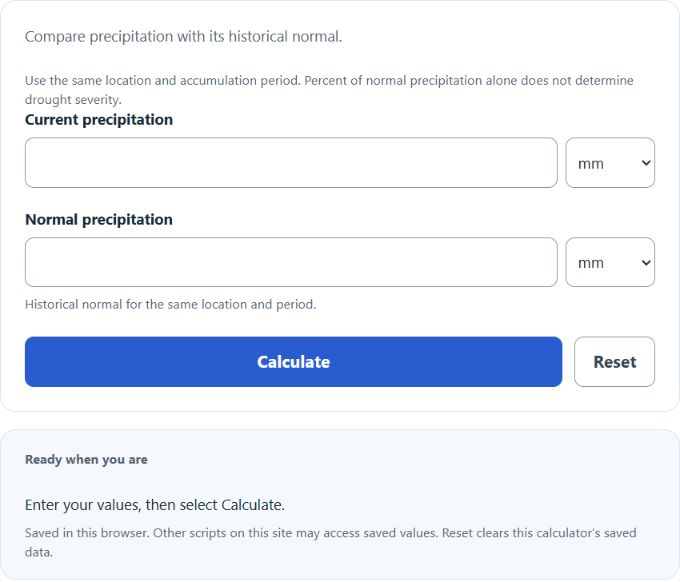
Calculate percent of normal precipitation, the precipitation ratio, and the amount above or below normal. This comparison alone does not classify drought severity.
Drought / Aridity Index Formulas
The calculator above uses percent of normal = current precipitation ÷ normal precipitation × 100. The other drought/aridity formulas below are background references and are not calculated by this widget; SPI and KBDI require their full specialized procedures.
Variables:
- P is precipitation for the selected period (consistent depth units; use millimeters for the displayed IdM relationship); PET is potential evapotranspiration for the same period.
- T is mean air temperature for the selected period (in °C in the IdM formula); k is a period factor (k=1 annual, k=4 seasonal, k=12 monthly).
- μ is the historical mean precipitation and σ is the historical standard deviation (same timescale and units as P). KBDI is a 0–800 index (hundredths of an inch of soil moisture deficit); Rnet is effective rain in inches (max(0, R − 0.20 in)); dQ is the daily drought factor term in KBDI units.
To calculate percent of normal, enter current and historical normal precipitation for the same location and accumulation period, choose each depth unit, and select Calculate. No drought severity category is assigned.
What is a Drought Index?
A drought index is a quantitative indicator used to describe anomalously dry (or wet) conditions over a chosen time period and region. Different indices use different inputs and have different interpretations—for example, SPI standardizes precipitation anomalies, SPEI standardizes a precipitation minus PET water balance, and PDSI uses a simplified soil‑water balance model driven by precipitation and temperature. The U.S. Drought Monitor is not a single numerical index; it is a weekly composite map/classification that synthesizes multiple indicators and expert assessment.
How to Calculate Drought Index?
The following steps calculate percent of normal precipitation using the widget above.
- Enter current precipitation and the historical normal for the same location and accumulation period.
- Enter the required inputs for the same location and time period/timescale, and select the appropriate units.
- Normal precipitation must be greater than zero. Current precipitation may be zero.
- Click Calculate to view percent of normal, the ratio and the departure from normal.
- Use Reset to clear both fields, results and this calculator’s saved data.
Example Problem :
Percent-of-normal example: 400 mm current precipitation ÷ 1000 mm normal precipitation × 100 = 40%. This is not a drought severity classification.
Total precipitation for the period (P) = 400 mm
Historical normal precipitation for the same period = 1000 mm