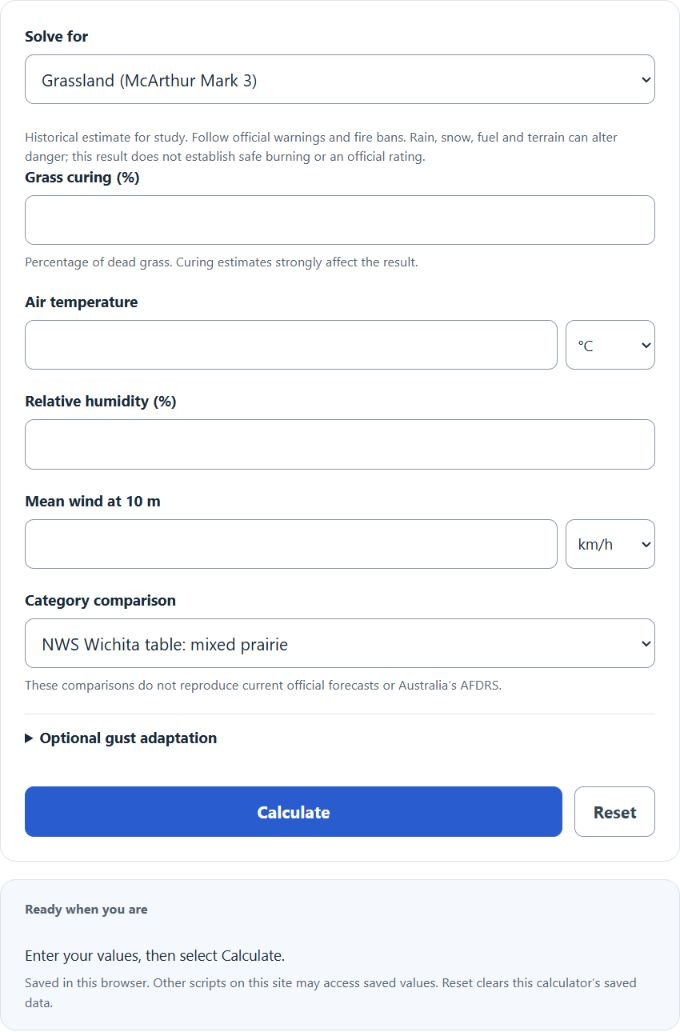
Explore historical McArthur grassland GFDI or forest FFDI from curing or drought factor, temperature, humidity and wind. Category comparisons are educational; follow current official warnings and fire bans.
- All Miscellaneous Calculators
- Grass Seed Calculator
- Fire Flow Calculator
- Humidity Ratio Calculator
- NDVI Calculator
- Sod Calculator
Grassland Fire Danger Index Formula
The following equation describes the historical McArthur Mark 3 grassland meter (Noble, Bary and Gill, 1980), including its factor of 2. It is not Australia’s current AFDRS implementation.
GFDI = 2 * exp( -23.6 + 5.01 * ln(C) + 0.0281 * T – 0.226 * sqrt(RH) + 0.633 * sqrt(U) )
- GFDI is the Grassland Fire Danger Index
- C is the degree of curing of grass fuels (%) (0–100; use the mathematical zero limit at C = 0)
- T is the air temperature in degrees Celsius (°C)
- RH is the relative humidity (%)
- U is the wind speed at 10 m in km/h
- ln(.) is the natural logarithm and exp(.) is the natural exponential (ex)
For positive curing, combine the logarithmic curing term with temperature, humidity and mean open wind at 10 m, then multiply the exponential by 2. At zero curing the calculator uses the equation’s mathematical limit of zero; this does not mean real-world fire risk is zero. Optional mean-and-gust averaging is a labeled US adaptation.
What is a Grassland Fire Danger Index?
The historical GFDI describes potential grassfire behavior from weather and curing. Mark 3 was developed for average pastures in the southern NSW/ACT tablelands. This calculator compares its numerical estimate with attributed NWS Wichita prairie tables or pre-2022 Australian bands; it does not reproduce a current official forecast. NWS thresholds depend on local climatology. Current Australian AFDRS uses different fire-behavior models. Rain, snow, fuel, terrain and local conditions can change danger. A low index does not establish safe burning.
How to Calculate Grassland Fire Danger Index?
The following steps outline how to calculate the Grassland Fire Danger Index (GFDI) using the given formula:
- First, determine the degree of curing (C) as a percentage from 0–100.
- Next, determine the temperature in degrees Celsius (T).
- Next, determine the relative humidity (RH) as a percentage.
- Next, determine the wind speed at 10 m in km/h (U).
- Using the formula GFDI = 2 * exp( -23.6 + 5.01 * ln(C) + 0.0281 * T – 0.226 * sqrt(RH) + 0.633 * sqrt(U) ), substitute the values of C, T, RH, and U into the formula.
- Finally, calculate the Grassland Fire Danger Index (GFDI) using the substituted values.
Example Problem:
Use the following variables as an example problem to test your knowledge:
degree of curing (C) = 70%
temperature (T) = 25°C
relative humidity (RH) = 50%
wind speed (U) = 20 km/h