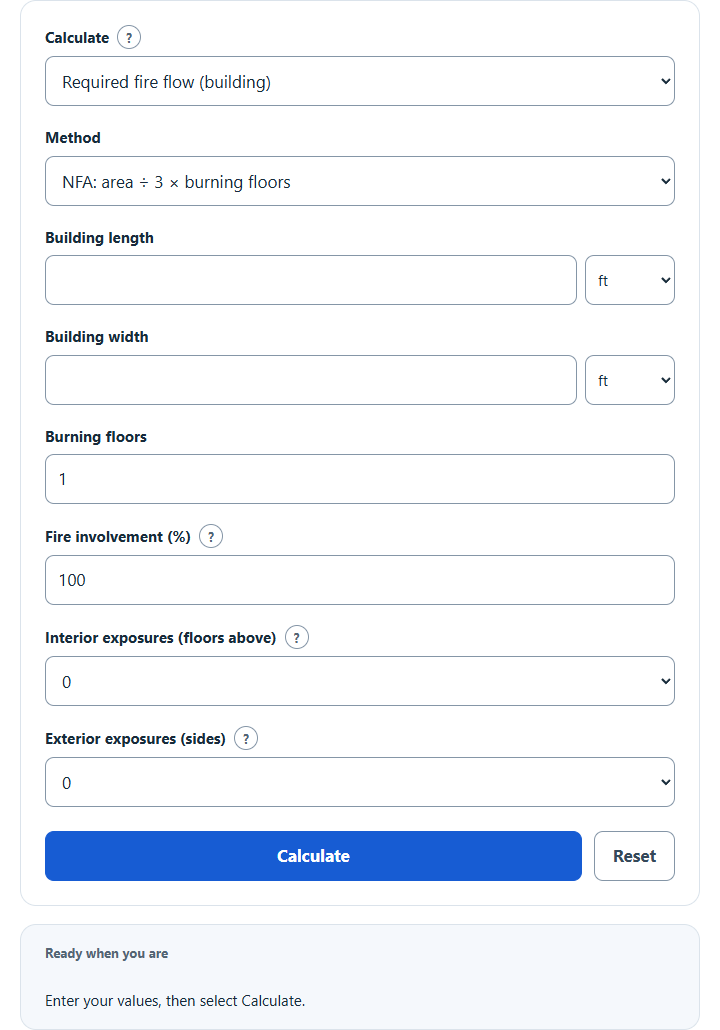
Calculate fire flow in GPM with the NFA (area ÷ 3) or Iowa (volume ÷ 100) formula, or find hydrant flow from a pitot reading and project it to 20 psi.
- All Construction Calculators
- Fire Load Calculator
- GPM (Gallons Per Minute) Calculator
- Hose Flow Rate Calculator
- Water Flow Rate Calculator
- Pipe Flow Calculator
- GPM to Pipe Size Calculator
Fire Flow Formula
The following two formulas are the two most common formulas used to calculate fire flow.
- Where RFF is the required fire flow (GPM)
- L is the length (feet)
- W is the width (feet)
- H is the height (feet, used in the ISU method)
For the NFA method, multiply the length by the width, then divide by 3. For the ISU method, multiply the length by the width by the height, then divide by 100.
Fire Flow Definition
What is fire flow? Fire flow is a measure of the total rate of water flow required to suppress a fire. Fire flow is most often expressed in gallons per minute. It’s often used as a rough estimate as opposed to an exact measure.
Example Problem
How to calculate fire flow?
- First, determine the length of the area on fire.
For this example, the length is 10 ft.
- Next, determine the width of the area.
For this example, the width is 20 ft.
- Next, determine the height.
In this problem the height is 8 ft.
- Finally, calculate the fire flow.
Using the formula (ISU method): 10*20*8/100 = 16 gpm