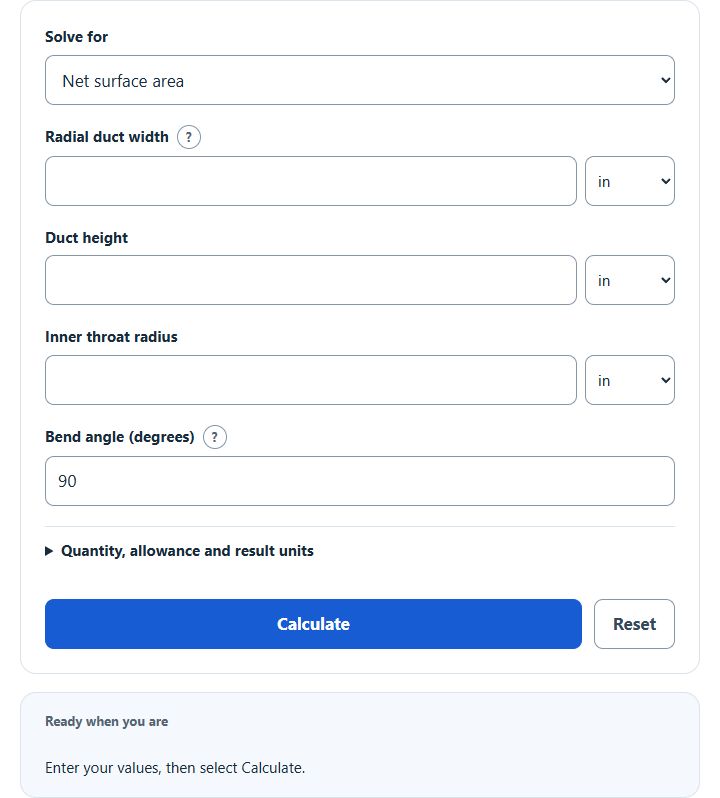
Calculate duct elbow surface area for a rectangular duct bend from width, height, throat radius and bend angle, or solve for the throat radius or angle.
- All Construction Calculators
- Return Air Duct Size Calculator
- Duct Velocity Calculator
- CFM Per Ton Calculator
- Air-Flow Calculator
Duct Bend Area Formula
This calculator estimates the four-wall net surface of an ideal rectangular radius bend with open ends. Width W runs radially, height H is perpendicular to the bend, and R is the inner throat radius. It excludes seams, flanges, straight extensions, vanes and metal thickness.
- A = total net area for Q identical bends
- W, H and R use the same length unit; theta is degrees.
- Throat panel = t*R*H; heel panel = t*(R+W)*H.
- Two cheeks combined = t*((R+W)2 – R2).
Select area, inner radius or angle from the solve menu. Fill the visible required measurements. Quantity defaults to one if blank; the optional allowance adds a percentage over net area only in area mode. Inverse target area is the net total for all bends, excluding allowance.
A negative solved radius or an angle above 180 degrees is rejected. Zero radius is only a mathematical boundary, not a fabrication recommendation. These equations follow circular arc and annular-sector geometry: OpenStax, Angles.
Common Bend Angle Multipliers
The bend angle is used as a fraction of a full 360-degree circle.
| Bend Angle | Multiplier theta/360 | Typical Description |
|---|---|---|
| 30° | 0.0833 | Small offset bend |
| 45° | 0.1250 | Common transition bend |
| 60° | 0.1667 | Moderate bend |
| 90° | 0.2500 | Quarter-turn elbow |
| 180° | 0.5000 | Half-circle return bend |
Length and Area Unit Conversions
Each length has its own unit selector. Lengths are converted to meters and areas to square meters internally, then results use the selected unit. The table gives equivalent conversions; displayed decimals are approximate.
| Unit | Conversion Used | Type |
|---|---|---|
| 1 ft | 12 in | Length |
| 1 cm | 0.393701 in | Length |
| 1 m | 39.3701 in | Length |
| 1 sq ft | 144 sq in | Area |
| 1 sq cm | 0.1550 sq in | Area |
| 1 sq m | 1550 sq in | Area |
Duct Bend Area Examples
Example 1: Calculate duct bend area
Given:
- Width = 24 in
- Height = 12 in
- Bend radius = 18 in
- Bend angle = 90°
- Quantity = 1
The total net surface area is 3392.9201 square inches, or 23.5619 square feet. The old 47.1239 figure was a centerline arc length in inches, not an area.
Example 2: Calculate bend angle
Given:
- Total net area = 6785.8401 sq in
- Width = 24 in
- Height = 12 in
- Bend radius = 18 in
- Quantity = 2
The bend angle is 90.00 degrees.
Duct Bend Area FAQ
How do I choose the unknown value?
Select net area, inner throat radius or bend angle in the solve menu. The unknown input is removed; complete the remaining required measurements. Width and height are inputs, not additional solve modes.
What does quantity mean in the duct bend area formula?
Quantity is the positive whole number of identical duct bends. A blank quantity means one. If one bend has a net area of 23.5619 sq ft and the quantity is three, total net area is about 70.6858 sq ft. Per-bend panel areas stay unchanged.
Can I mix inches, feet, centimeters, and meters?
Yes. Width, height and inner radius have independent length units. Target area has its own area unit, and the result-unit control selects the panel-area display. Unit changes preserve the entered physical quantity.