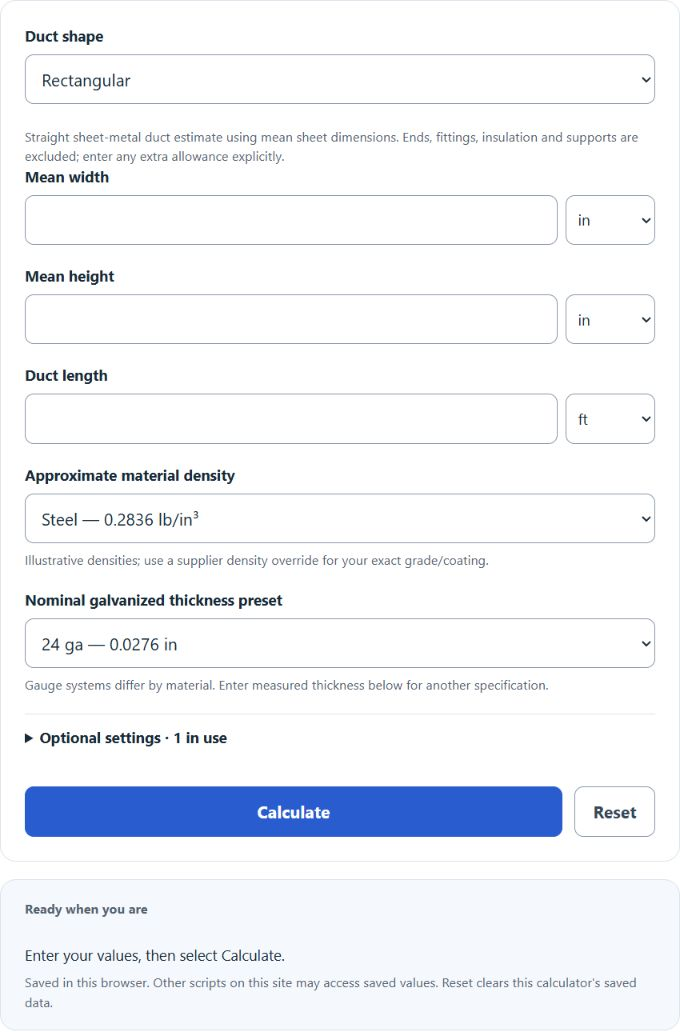
Estimate rectangular or round sheet-metal duct mass from mean dimensions, length, thickness and material density. Optional overrides, an explicit extra mass allowance and a USD-per-pound price are available.
- All Weight Calculators
- Return Air Duct Size Calculator
- Duct Bend Area Calculator
- Duct Volume Calculator
Duct Weight Formula
The following thin-wall formula estimates a rectangular duct shell using mean sheet dimensions; use consistent inch and pound units. Ends, fittings, insulation and supports are excluded.
Variables:
- DW is the Duct Weight (lbs)
- H is the duct height (in)
- W is the duct width (in)
- L is the duct length (in)
- T is the duct thickness (in)
- D is the duct density (lbs/in^3)
- The approximate aluminum default is 0.0975 lb/in³. Use a supplier density for the specific alloy; the example below uses a custom 0.1 lb/in³ assumption.
For a rectangular shell, multiply 2(H + W) by length, thickness and density. For a round shell, replace 2(H + W) with π times the mean diameter. Multiply bare shell mass by (1 + allowance/100) only when an extra mass allowance is entered; blank means 0%. Nominal gauge presets are galvanized-steel thicknesses and do not specify the same gauge for other materials.
How to Calculate Duct Weight?
The following example outlines the calculation with a measured thickness of 0.25 in, custom density of 0.1 lb/in³ and no extra mass allowance. Enter the 200 in length using the length unit selector.
Example Problem #1
- First, determine the duct height (in).
- The duct height (in) is calculated to be 10.
- Next, determine the duct width (in).
- The duct width (in) is measured to be 15.
- Next, determine the duct length (in).
- The duct length (in) is found to be 200.
- Next, determine the duct thickness (in).
- In this case the thickness is .25 inches.
- Finally, calculate the Duct Weight using the formula above:
DW = ((2*(H+W))*L*T)*D
The values provided above are inserted into the equation below and computed.
DW = ((2*(10+15))*200*.25)*.1 = 250.00 (lbs)