Calculate equivalent annual cost, compare unequal-life assets, reverse a target purchase cost, or estimate project cost at completion with named PM methods.
- All Business Calculators
- Cost Variance Calculator
- Cost Function Calculator
- Fixed Cost Calculator
- Cost of Debt Calculator
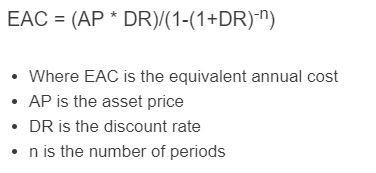
EAC Formula
The calculator uses the capital recovery factor to convert a present cost into an equal yearly payment over the asset’s life.
For asset modes, annualizing the present worth of the stated cash flows is equivalent to purchase × CRF + annual operating cost − salvage × SFF:
- EAC = equivalent annual cost
- PW = present worth of all costs
- P = purchase price or installed cost
- A = annual operating or maintenance cost
- S = salvage or resale value at end of life
- r = discount rate per year (decimal)
- n = useful life in years
Costs are treated as positive numbers and salvage as a positive recovery. End-of-year cash flow timing is assumed. If you enter a rate of 0%, the formula reduces to PW divided by n. Enter whole-year useful lives and annual operating costs, with zero explicitly entered when absent. USD is the calculation convention; no currency conversion is performed. Maximum-price mode rounds the solved limit down to whole cents.
Project estimate-at-completion is a different meaning of EAC. The four forecast scenarios are BAC/CPI; AC+(BAC−EV); AC+(BAC−EV)/(CPI×SPI); and AC+bottom-up ETC, where CPI=EV/AC and SPI=EV/PV. Use consistent scope and status dates, with EV and PV no greater than BAC. Ratio methods require positive denominators. These are assumptions about future performance, not commitments.
Reference Tables
Use the capital recovery factor to sanity-check a result. Multiply your present worth by the factor at your rate and life to get the EAC.
| Life (years) | 3% | 5% | 8% | 10% | 12% |
|---|---|---|---|---|---|
| 3 | 0.3535 | 0.3672 | 0.3880 | 0.4021 | 0.4163 |
| 5 | 0.2184 | 0.2310 | 0.2505 | 0.2638 | 0.2774 |
| 7 | 0.1605 | 0.1728 | 0.1921 | 0.2054 | 0.2191 |
| 10 | 0.1172 | 0.1295 | 0.1490 | 0.1627 | 0.1770 |
| 15 | 0.0838 | 0.0963 | 0.1168 | 0.1315 | 0.1468 |
| 20 | 0.0672 | 0.0802 | 0.1019 | 0.1175 | 0.1339 |
| 25 | 0.0574 | 0.0710 | 0.0937 | 0.1102 | 0.1275 |
The following rate ranges are illustrative scenarios, not current official recommendations. Choose a defensible rate for the decision, its risk and its real or nominal cash flows.
| Context | Illustrative rate range |
|---|---|
| Personal purchase, low-risk | 3% to 6% |
| Public sector or utility project | 3% to 7% |
| Corporate capital project (WACC) | 7% to 12% |
| Higher-risk equipment decision | 12% to 18% |
Worked Example
A machine costs $20,000, has $1,500 in annual maintenance, a $3,000 salvage value after 8 years, and the discount rate is 8%.
- Discount factor at year 8: 1 / (1.08)^8 = 0.5403
- PVAF = (1 – 0.5403) / 0.08 = 5.7466
- PW = 20,000 + 1,500 × 5.7466 – 3,000 × 0.5403 = $26,999
- CRF at 8%, 8 years = 0.1740
- EAC = 26,999 × 0.1740 = $4,698 per year
FAQ
When should you use EAC instead of NPV? Use EAC to annualize costs for equivalent service. Comparing each asset over its own life requires a repeatable-replacement assumption; otherwise use a common analysis horizon with explicit replacements and residual values. NPV is not inherently unfair to longer-lived projects.
Why does a higher discount rate increase EAC? A higher rate raises the cost of tying up capital, so the annualized burden of the upfront purchase grows.
Can EAC be negative? Yes. If salvage value at the chosen rate exceeds the present worth of purchase and operating costs, the EAC turns negative. This is rare and usually points to a low rate or an inflated salvage estimate.
Should operating costs include taxes and inflation? Use real costs with a real discount rate, or nominal costs with a nominal rate. Mixing them distorts the result.