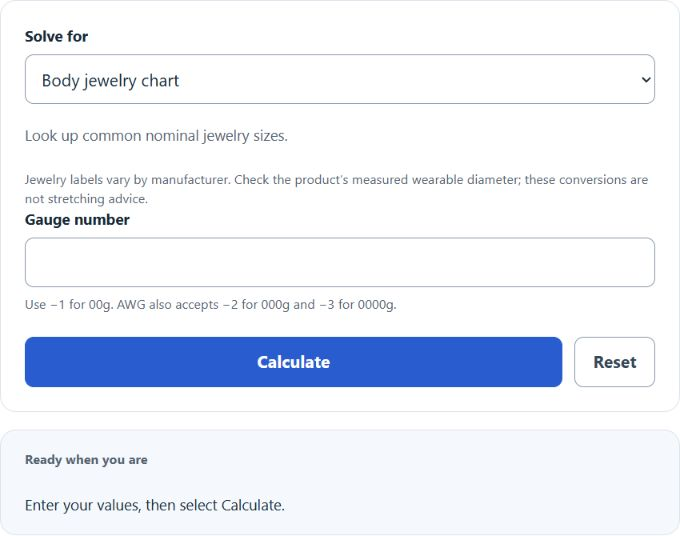
Convert ear gauge sizes to approximate millimeters using a nominal body jewelry chart or the AWG wire-gauge formula. Manufacturer dimensions can differ.
- Optical Zoom To mm Calculator
- mm To Points Calculator
- Carat to Ounces Conversion Calculator
- Measurement Ratio Calculator
- All Unit Converters
Ear Gauge to mm Formula
The following formula is used to estimate the diameter in millimeters from an ear gauge size using the American Wire Gauge (AWG) relationship.
Variables:
- d(mm) is the diameter in millimeters
- g is the gauge number
- 0g uses g = 0
- 00g uses g = -1
- 000g uses g = -2
To calculate ear gauge size in millimeters, substitute the gauge number into the formula above. The jewelry option uses a discrete nominal chart and rejects unsupported labels. It does not silently substitute the AWG formula.
What is Ear Gauge to mm Conversion?
Ear gauge to mm conversion is the process of translating a jewelry gauge size, such as 18g, 8g, 2g, or 00g, into its approximate diameter in millimeters. Jewelry gauge labels are related to AWG, but nominal jewelry diameters can differ from the wire-gauge formula. Smaller gauge numbers usually indicate thicker jewelry. Because the system is not linear, the conversion from gauge to millimeters is best handled with a reference chart or the AWG equation.
For example, 18g is about 1.02 mm, 14g is about 1.63 mm, and 2g is about 6.54 mm when calculated using the AWG formula. Jewelry charts often round these values to cleaner numbers such as 1.0 mm, 1.6 mm, or 6.0 mm.
How to Convert Ear Gauge to mm?
The following steps outline how to convert an ear gauge size to millimeters.
- First, determine the ear gauge size you want to convert, such as 20g, 18g, 8g, 0g, or 00g.
- Next, decide whether to use a rounded body jewelry chart or the AWG wire-gauge formula.
- Then, calculate the diameter in millimeters using d(mm) ≈ 0.127 × 92(36 − g)/39, or look up the rounded chart value.
- Finally, compare the result with the calculator above to verify the approximate millimeter diameter.
Ear Gauge to mm Conversion Table
The table below shows common ear gauge sizes and their approximate diameters in millimeters using the AWG-based relationship.
| Gauge Size | Typical Labeling | Diameter in mm (AWG) |
|---|---|---|
| 20g | small starter lobe piercing | 0.81 mm |
| 18g | standard lobe jewelry | 1.02 mm |
| 16g | slightly thicker lobe / cartilage | 1.29 mm |
| 14g | heavier lobe or small stretching | 1.63 mm |
| 12g | early stretching size | 2.05 mm |
| 10g | moderate stretch | 2.59 mm |
| 8g | common stretched lobe size | 3.26 mm |
| 6g | larger stretched lobe | 4.11 mm |
| 4g | noticeably stretched lobe | 5.19 mm |
| 2g | large stretched lobe | 6.54 mm |
| 0g | very large gauge | 8.25 mm |
| 00g | also written 2/0 | 9.27 mm |
Manufacturer labels differ; for example, 00g may be sold as 9 mm or 10 mm, while AWG gives about 9.27 mm. Check the product’s measured wearable diameter. The calculator retains the original nominal chart, including 10g = 2.4 mm. See the BodyVibe jewelry size guide and the NBS Copper Wire Tables. This conversion does not recommend a stretching increment.
Example Problem:
Use the following values as an example problem to test your knowledge.
Gauge Size = 18g
Reference Scale = AWG Formula
Diameter in mm ≈ 1.02 mm