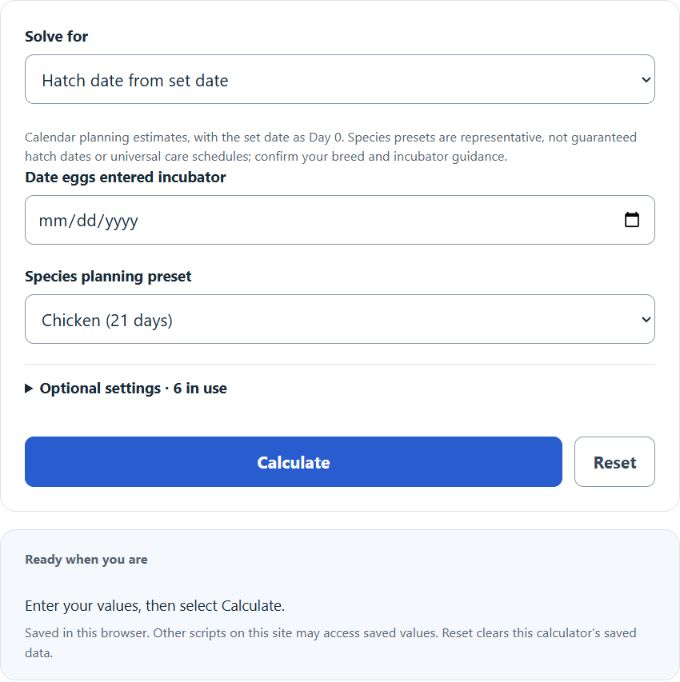
Calculate your egg incubation hatch date, lockdown day, and candling schedule from the set date, or work backward from a target hatch date.
Egg Incubation Hatch Date Formula
The calculator anchors every milestone to two facts: the day the eggs enter the incubator and the incubation period for the species. The core relationships are below.
Hatch Date = Set Date + Incubation Days
Lockdown Date = Hatch Date - Lockdown Lead
Set Date = Target Hatch Date - Incubation Days
Variables:
- Set Date is the calendar day the eggs are placed in a warm incubator (Day 0).
- Incubation Days is the species incubation period in whole calendar days (chicken 21, duck 28, quail 17, and so on).
- Hatch Date is a projected hatch date from the selected incubation period; it does not predict the exact onset of external pipping.
- Lockdown Lead is the planning offset before hatch for stopping turning. Three days is the chicken preset; other species and equipment can require different timing and humidity.
- Lockdown Date is the day turning stops.
- Target Hatch Date is the day you want chicks to hatch when planning backward.
Forward mode adds whole calendar days to the set date; reverse mode subtracts them from a target hatch date. Optional check reminders are shown only before the selected stop-turning date. The default one-day-before/two-days-after buffer and two-day brooder-ready lead are editable planning choices, not a guaranteed biological hatch window.
Incubation Periods and Lockdown Days by Species
These representative planning presets follow Texas A&M AgriLife Table 1. Incubation periods and transfer days can vary; confirm species, breed and incubator instructions. Check days are optional reminders, not universal candling instructions.
| Species | Incubation Days | Lockdown Day | Candle Days |
|---|---|---|---|
| Chicken | 21 | 18 | 7, 14 |
| Duck (domestic) | 28 | 25 | 7, 14 |
| Muscovy duck | 35 (published range 35–37) | 31 (range 31–33) | 7, 14 |
| Turkey | 28 | 25 | 7, 14 |
| Goose | 30 | 27 | 7, 14 |
| Quail (Coturnix) | 17 (range 17–18) | 15 | 7, 14 |
| Quail (Bobwhite) | 23 | 21 | 7, 14 |
| Guinea fowl | 28 | 22 | 7, 14 |
| Pheasant | 24 | 21 | 7, 14 |
| Peafowl | 28 | 25 | 7, 14 |
| Pigeon | 18 (range 17–19) | 14 | 7 |
| Emu | 50 (range 49–50) | 47 | Confirm species guidance; no default reminders |
| Ostrich | 42 | 39 | 7, 14 |
Temperature requirements differ by species and equipment. Texas A&M lists 99.5°F for chicken incubation and 97.5°F for emu and ostrich; these are not interchangeable universal settings. See Texas A&M AgriLife, Incubating and Hatching Eggs, Table 1.
The hatch date is only half of the planning problem. How long the eggs sat before you set them changes how many will hatch at all, which affects how many chicks you should expect on the date the calculator gives you. The table below is a qualitative storage planning guide, not a prediction of hatch percentage. Texas A&M advises setting eggs within 7–10 days under appropriate storage conditions (55–65°F and 75% relative humidity); viability also depends on fertility, handling and sanitation.
| Storage Before Setting | Typical Hatchability | Note |
|---|---|---|
| 0 to 3 days | No guaranteed percentage | Freshness alone does not establish viability |
| 4 to 7 days | Depends on conditions | Maintain suitable storage temperature and humidity |
| 8 to 10 days | Risk increases with storage duration | Follow storage and turning guidance |
| 11 to 14 days | Sharp drop | Expect fewer chicks |
| Over 14 days | Low | Not recommended for setting |
Longer storage can reduce hatchability and alter timing. The calculator does not model storage effects or estimate viability, and its planning buffer is not a validated interval for older eggs.
Example Problems
Example 1: Chicken eggs. You set a batch of chicken eggs on April 1. The incubation period is 21 days, so the hatch date is April 1 plus 21 days, which is April 22. Lockdown is three days earlier on April 19 (day 18). Candling falls on April 8 (day 7) and April 15 (day 14). You should have the brooder ready by April 20.
Example 2: Planning backward for quail. You want Coturnix quail to hatch on May 27 for a fair. The incubation period is 17 days, so the set date is May 27 minus 17 days, which is May 10. The 17-day Coturnix preset uses a day-15 stop-turning planning date, May 25, following Texas A&M Table 1. Optional day-7 and day-14 reminders fall on May 17 and May 24. Confirm actual turning and candling guidance for your birds and equipment.
Frequently Asked Questions
Should I count from the day the egg was laid or the day I set it? Count from the day you set it in the incubator. Incubation only begins when the egg reaches incubation temperature. Eggs can be stored cool for several days before setting without starting to develop, so the lay date is not the start of the clock.
What does lockdown mean? It is the hatch-stage transition when turning stops and equipment settings may change. Timing varies by species and incubator. The calculator supplies an editable date offset; it does not prescribe temperature, humidity, ventilation or when to open an incubator.
Why is there a planning buffer? Actual hatch timing depends on biology, storage and incubation conditions. The default one-day-before/two-days-after buffer is an editable scheduling allowance, not a statistical interval or a viability test.