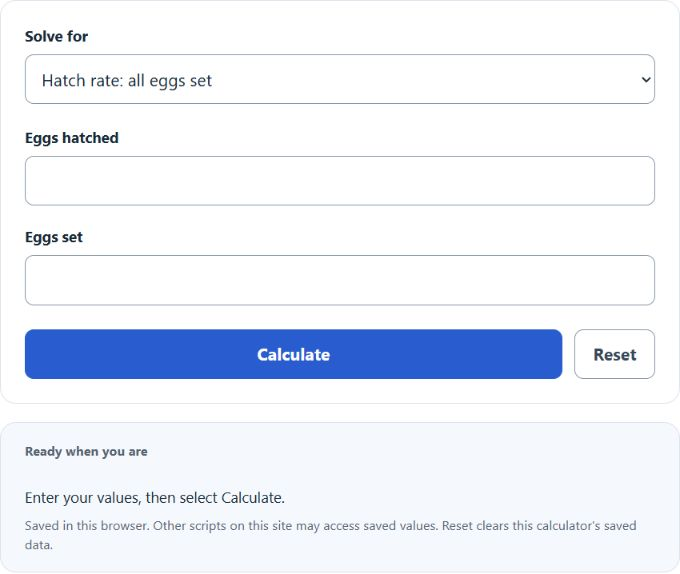
Calculate hatch rate of all eggs set, hatchability of fertile eggs, fertility rate, or estimated hatchability using a known fertility percentage.
- All Biology Calculators
- Chicken Hatch Date Calculator
- Chicken Yield Calculator
- Percent Germination Calculator
- Success Percentage Calculator
- Percentage Calculator
Calculator Functions
| Function | What it does | What it requires |
|---|---|---|
| Hatch rate: all eggs set | Finds the percentage of all the eggs placed in the incubator that hatched | Requires the number of eggs hatched and the number of eggs set |
| Hatchability: fertile eggs | Finds the percentage of the fertile eggs that hatched, leaving infertile eggs out of the count | Requires the number of eggs hatched and the number of fertile eggs |
| Estimated hatchability from fertility rate | Estimates the hatchability of fertile eggs when the fertile eggs were not counted | Requires the number of eggs hatched, the number of eggs set and an estimated fertility rate in percent |
| Fertility rate | Finds the percentage of the eggs set that were fertile | Requires the number of fertile eggs and the number of eggs set |
All counts are whole eggs from the same batch. Each result also shows the number of eggs in its denominator and how many of them are not in the numerator.
Hatch Rate Formulas
| HR | Hatch rate of all eggs set (%) |
| EH | Eggs hatched |
| ES | Eggs set: every egg placed in the incubator |
Hatch rate counts chicks against every egg set, fertile or not [1]. The other functions change what is counted on the top or the bottom of the fraction, so two percentages can only be compared when they use the same one.
Hatch rate: all eggs set
The main formula applies directly. If 40 of 50 eggs set hatch, the hatch rate is 40 ÷ 50 × 100 = 80%. More eggs hatched than eggs set is rejected.
Hatchability: fertile eggs
EF is the number of fertile eggs. If 45 of those 50 eggs were fertile, hatchability is 40 ÷ 45 × 100 = 88.889%. Infertile eggs cannot hatch whatever the incubator does, so this figure reflects incubation and egg handling more than the breeding flock [2].
Estimated hatchability from fertility rate
(ES × F ÷ 100) × 100
F is the estimated fertility rate in percent, so ES × F ÷ 100 is the estimated number of fertile eggs. With 40 hatched, 50 set and 90% fertility that is 45 fertile eggs and 88.889% again. The estimate can come out as a fraction of an egg. The result also shows the hatch rate of all eggs set.
Fertility rate
With 45 fertile eggs out of 50 set, fertility is 90%. Multiplying fertility by hatchability of fertile eggs gives the hatch rate: 90% × 88.889% = 80%.
Limits of This Estimate
- Hatchability of fertile eggs is only as good as the fertile count. Candling alone tends to count embryos that died in the first days as infertile, which understates fertility [2].
- No result is graded as good or poor, because that depends on the species, the age of the breeding flock, egg handling and the incubator. As a reference, commercial broiler hatcheries expect about 85 chicks per 100 eggs set in optimal conditions, and 81% to 82% or less is common [1].
- Estimated hatchability from fertility rate depends entirely on the fertility figure entered. It is not evidence of which eggs were fertile.
Sources
- University of Florida IFAS Extension, A Systematic Approach to Solving Hatchability and Chick Quality Problems (VM101): hatch counted as chicks per 100 eggs set, and typical commercial figures
- Pas Reform Hatchery Technologies, Do we understand ‘hatch of fertile’ correctly?: hatch of fertile formula, and why fertility is easy to misjudge