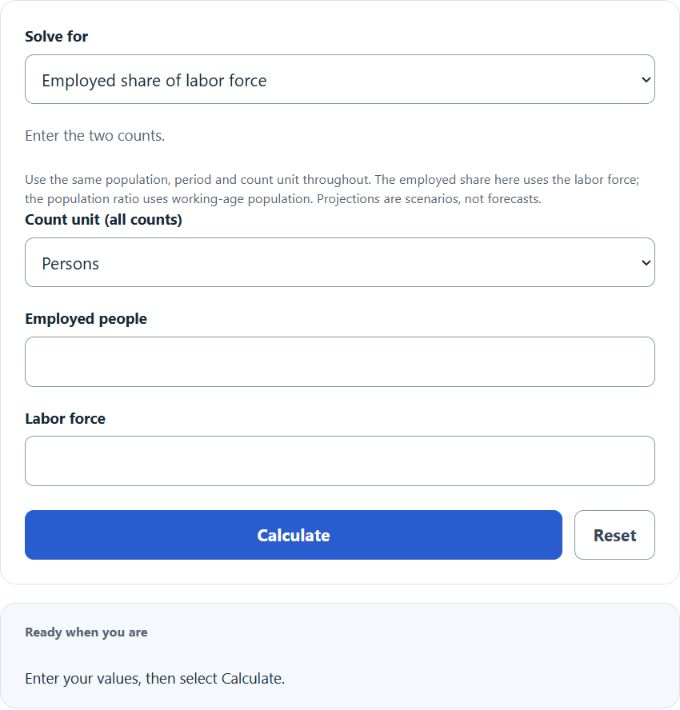
Calculate employment rate, unemployment rate, employment-to-population ratio, labor force participation rate, and jobs needed to reach target unemployment.
- All Statistics Calculators
- Natural Rate of Unemployment Calculator
- Labor Productivity Calculator
- Effective Labor Rate Calculator
Employment Rate Formula
The following formula is used to calculate the employment rate (the share of the labor force that is employed).
- Where ER is the employment rate (%)
- E is the total number of people employed
- LF is the total number of people in the labor force (employed + unemployed people, including active job seekers and people on temporary layoff awaiting recall)
To calculate the employed share of the labor force, divide employed people by the labor force and multiply by 100. Use the separate population-ratio mode when the denominator is working-age population.
Employment Rate Definition
An employment rate (as used here) is defined as the percentage of the labor force that is employed. This measure equals 100% minus the unemployment rate when both are based on the same labor force.
Employment Rate Example
How to calculate employment rate?
- First, determine the total number of employed individuals.
For this example, we will say the total number of people employed is 1,000.
- Next, determine the total labor force.
For this example we will say the labor force is 2,000.
- Finally, calculate the employment rate.
Using the formula above, we find the employment rate to be 1,000/2,000 * 100 = 50%.
FAQ
The employment rate is a percentage of the total labor force that is currently employed.
The labor force includes people who are employed plus people who are unemployed (including active job seekers and people on temporary layoff awaiting recall) (it excludes those not in the labor force).