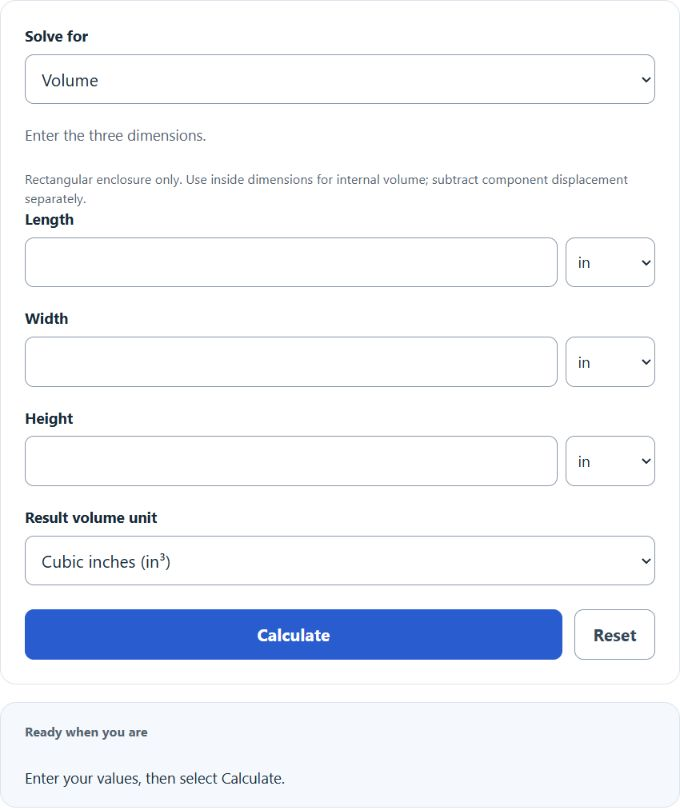
Choose volume, length, width, or height to solve from three known values in inches, feet, cm, or meters, with volume shown.
Enclosure Volume Formula
The enclosure volume calculator uses the rectangular box volume formula. Choose the value to solve for and enter the other three known values.
- V = enclosure volume
- L = enclosure length
- W = enclosure width
- H = enclosure height
The calculator converts length, width, and height to inches before applying the formula. Volume is calculated in cubic inches first, then converted to the volume unit you select.
- Calculate volume: enter length, width, and height.
- Calculate length: enter volume, width, and height.
- Calculate width: enter volume, length, and height.
- Calculate height: enter volume, length, and width.
Common Enclosure Volume Unit Conversions
Use these conversions to check or interpret the result when switching between inch, foot, centimeter, and meter-based units.
| Conversion | Equivalent |
|---|---|
| 1 cubic foot | 1,728 cubic inches |
| 1 cubic inch | 16.387064 cubic centimeters |
| 1 cubic centimeter | approximately 0.0610237 cubic inches |
| 1 cubic meter | approximately 61,023.7 cubic inches |
Typical Enclosure Volume Reference
| Inside Dimensions | Volume in Cubic Inches | Volume in Cubic Feet |
|---|---|---|
| 12 in × 12 in × 12 in | 1,728 cu in | 1.000 cu ft |
| 18 in × 12 in × 10 in | 2,160 cu in | 1.250 cu ft |
| 24 in × 18 in × 12 in | 5,184 cu in | 3.000 cu ft |
| 30 in × 20 in × 15 in | 9,000 cu in | 5.208 cu ft |
Example Calculations
Example 1: Calculate enclosure volume
You have an enclosure that is 20 inches long, 14 inches wide, and 10 inches high.
The enclosure volume is 2,800 cubic inches. In cubic feet, this is:
Example 2: Calculate missing height
You need a 1.5 cubic foot enclosure with a length of 18 inches and a width of 12 inches.
First convert the volume to cubic inches:
Then solve for height:
The missing height is 12 inches.
FAQ
Does enclosure volume use inside or outside dimensions?
Use the inside dimensions for gross internal geometric volume. Subtract driver, port, bracing and other component displacement separately to find net usable volume. Outside dimensions include the wall thickness, so they usually overstate the space inside the enclosure.
Which three values should I enter?
The rectangular enclosure formula has four values: length, width, height, and volume. If three are known, the fourth can be calculated. If fewer than three values are entered, there is not enough information. Choose the target in Solve for; its input is hidden so only the three required known values are entered.
Can I mix units, such as inches for length and centimeters for width?
Yes. The calculator converts each dimension to inches internally, performs the calculation, and then converts the result to the selected output unit.