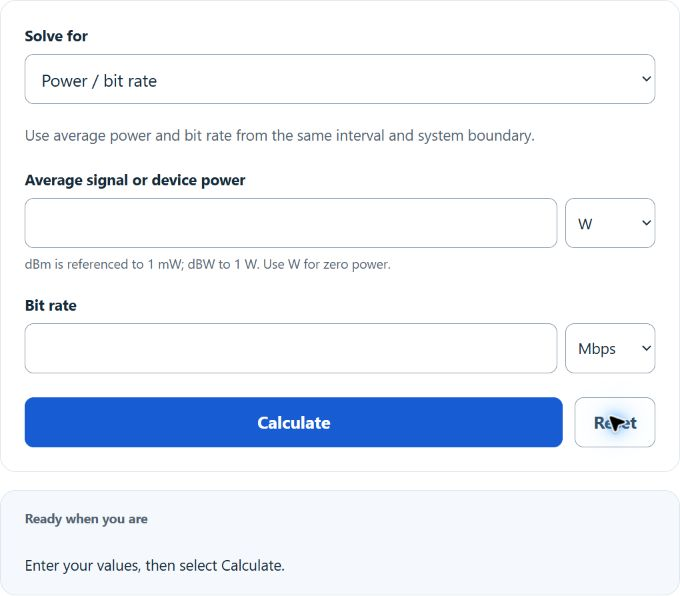
Calculate energy per bit from power and bit rate, voltage and current, or total energy and data sent with unit conversions for watts, volts, and bits.
Energy Per Bit Formula
Energy per bit (Eb) is the average energy needed to transmit or process one bit. The calculator uses one of three forms depending on what you know.
- Eb = energy per bit, in joules per bit (J/bit)
- P = average power, in watts (W)
- Rb = bit rate, in bits per second (bps)
- V = supply voltage, in volts (V)
- I = average current draw, in amperes (A)
- E_total = total energy used over the measurement window, in joules (J)
- N_bits = total number of bits sent in that same window
Power values entered in dBm or dBW are converted to watts before division. Bytes are treated as 8 bits, and decimal SI prefixes (k = 10³, M = 10⁶, G = 10⁹) are used for both data and bit rate. The result is an average over the interval you measure, so include idle and overhead time in P or E_total if you want a system-level figure rather than a peak link figure.
Illustrative Energy Scales
The following broad scale examples are illustrative, not validated performance benchmarks. Device, workload, measurement boundary and bit definition can change the result substantially. Compare measured like-for-like values rather than using these ranges as limits.
| System | Illustrative Eb scale |
|---|---|
| On-chip digital logic (modern CMOS) | 0.1 to 10 fJ/bit |
| Short-reach SerDes / chip-to-chip | 1 to 10 pJ/bit |
| DRAM access | 10 to 100 pJ/bit |
| Bluetooth Low Energy radio | 1 to 50 nJ/bit |
| Wi-Fi (active radio) | 10 to 500 nJ/bit |
| LoRa / sub-GHz IoT | 1 to 100 µJ/bit |
| Cellular uplink (LTE) | 0.1 to 10 µJ/bit |
| Unit | Value in joules |
|---|---|
| 1 mJ | 10⁻³ J |
| 1 µJ | 10⁻⁶ J |
| 1 nJ | 10⁻⁹ J |
| 1 pJ | 10⁻¹² J |
| 1 fJ | 10⁻¹⁵ J |
Worked Example
For an RF-only example, a radio transmits at 20 dBm (100 mW) with a sustained throughput of 10 Mbps. This does not include supply or protocol overhead energy.
- Convert power: 20 dBm = 10^((20−30)/10) = 0.1 W
- Convert rate: 10 Mbps = 10,000,000 bps
- Eb = 0.1 / 10,000,000 = 1 × 10⁻⁸ J/bit = 10 nJ/bit
Why is my Eb so much higher than the radio’s TX power suggests? Because real systems spend energy on the MCU, oscillators, protocol overhead, retransmissions, and idle listening. Dividing total measured energy by useful payload bits gives a different system-level metric from RF transmit energy per bit.
Should I use raw bits or payload bits? Use payload bits if you care about delivered information. Use raw channel bits if you are comparing modulation or coding schemes.
Does Eb depend on data rate? Yes. Higher Rb at the same power lowers Eb, but only if the radio or link can actually sustain that rate without raising power.