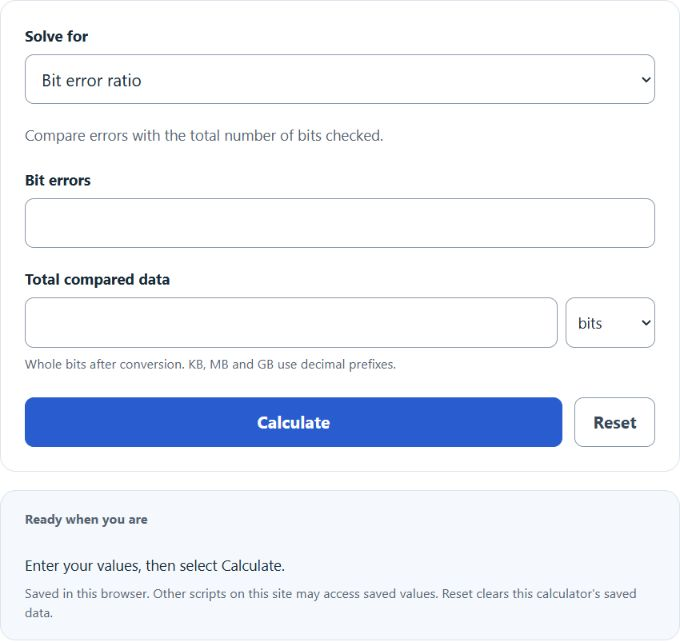
Calculate BER, expected bit errors, required test bits, and zero-error test duration from transmitted bits, confidence level, and data rate.
- All Statistics Calculators
- Bandwidth Calculator
- Bandwidth Delay Product Calculator
- Video File Size Calculator
- Packets Per Second Calculator
Bit Error Rate Formula
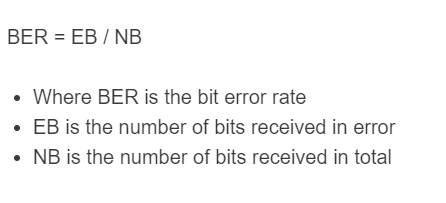
The following formula can be used to calculate a bit error rate.
- Where BER is the bit error rate
- EB is the number of bits received in error
- NB is the number of bits received in total
To calculate bit error rate, divide the number of bits in error by the total bits received.
Bit Error Rate Definition
A bit error rate is a measure of the quality of the digital transmission of a system. It’s defined as the ratio of bits received in error divided by the total number of bits received.
Bit Error Rate Example
How to calculate a bit error rate?
- First, determine the total number of bits.
Calculate the total number of bits received.
- Next, determine the number of errors.
Calculate the total number of bits received in error.
- Finally, calculate the bit error rate.
Calculate the bit error rate by dividing the bit errors by total bits.
FAQ
A bit error rate is a ratio of the total number of bits received in error to the total number of bits.