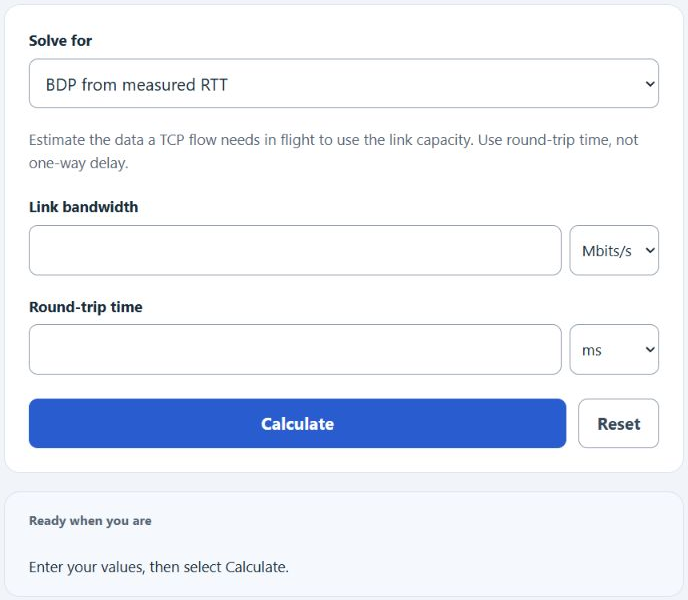
Select BDP from measured RTT, Window-limited throughput, or BDP from path distance. Enter the requested values and select Calculate. Results are ideal estimates, not measured throughput or complete TCP tuning recommendations.
- All Miscellaneous Calculators
- Bandwidth Calculator
- Video File Size Calculator
- Rise Time Calculator
- Bandwidth Per User Calculator
Bandwidth Delay Product Formula
The calculator uses one of three formulas depending on the mode you pick.
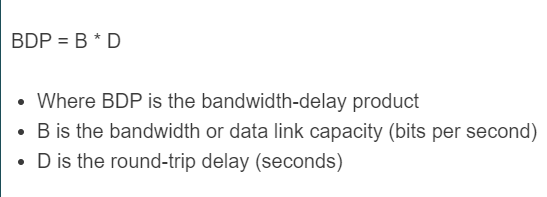
BDP from bandwidth and RTT:
Throughput from TCP window and RTT:
BDP from distance:
- BDP — bandwidth-delay product, the data in flight on the path
- Bandwidth — link capacity in bits per second
- RTT — round-trip time in seconds
- Window — usable TCP in-flight window in bytes, limited by congestion and receive windows; not necessarily the configured buffer size
- Distance — one-way path length
- Propagation speed — about 200,000 km/s in fiber, 299,792 km/s in free space
The distance mode gives a propagation-only estimate. Real RTT also includes queuing, serialization, and routing delay, so measured pings are usually higher than the calculated value. Divide BDP bits by 8 to get bytes, the size a TCP window must reach to fill the link.
Reference Values
Illustrative RTT assumptions by path type, not measured averages or guaranteed ranges. Use the measured RTT for your path:
| Path | Illustrative RTT |
|---|---|
| Same-rack LAN | 0.1 to 0.5 ms |
| Same-city ISP | 5 to 15 ms |
| Cross-country (US) | 60 to 90 ms |
| Transatlantic | 70 to 120 ms |
| Transpacific | 120 to 180 ms |
| Geostationary satellite | 500 to 700 ms |
BDP for common bandwidth and RTT pairs:
| Bandwidth | RTT | BDP |
|---|---|---|
| 100 Mbps | 40 ms | 500 KB |
| 1 Gbps | 40 ms | 5 MB |
| 1 Gbps | 100 ms | 12.5 MB |
| 10 Gbps | 80 ms | 100 MB |
| 10 Gbps | 600 ms | 750 MB |
Worked Example and Notes
Example. A 1 Gbps link with 80 ms RTT.
BDP = 1,000,000,000 × 0.080 = 80,000,000 bits = 10,000,000 bytes ≈ 10 MB.
An effective 64 KB window (64,000 bytes, not a universal default) gives an ideal window-limited rate of 64,000 × 8 / 0.080 = 6.4 Mbps, well under 1% of the link. An effective in-flight window of at least 10 MB avoids this particular bottleneck. Receive-window scaling is required above 65,535 bytes, but throughput also depends on congestion control, loss and other limits.
Why the 64 KB limit exists. The TCP header reserves 16 bits for the window field, giving a maximum of 65,535 bytes without the window scale option (RFC 7323). Modern stacks negotiate scaling automatically, but the OS buffer ceiling can still cap throughput.
Distance mode caveat. Enter the actual one-way route length; the calculator assumes the same return route. Fiber uses an approximate 200,000 km/s, free space 299,792.458 km/s, or a retained slower scenario of 150,000 km/s. The slower scenario is not a standard routed-fiber speed. Geographic straight-line distances omit route detours. Queuing, serialization and processing delays are excluded.