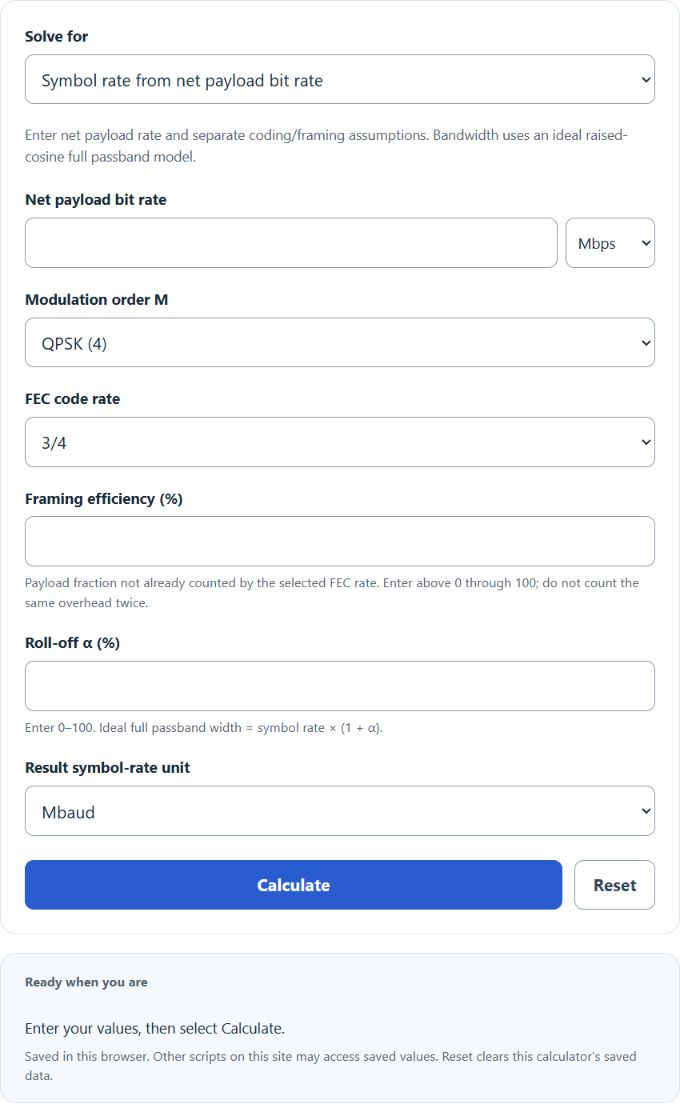
Calculate symbol rate from net payload rate, net payload rate from symbol rate, or modeled net rate from ideal raised-cosine passband bandwidth.
Related Calculators
- Audio Data Rate Calculator
- CPM To Hz Calculator
- nepers to dB Converter
- Seconds To Ticks Calculator
- All Unit Converters
Symbol Rate Formula
Symbol rate, measured in baud, is the number of symbols transmitted each second. For the supported binary modulation orders, each symbol maps k = log2(M) coded modulation bits. Choose one of three tasks: symbol rate from net payload rate, net payload rate from symbol rate, or modeled net rate from ideal passband bandwidth. Bits per symbol are derived from the selected modulation order, not entered as a separate unknown.
- SR
- Symbol rate in symbols per second (sps), kilosymbols per second (ksps), or megasymbols per second (Msps)
- BPS
- Gross modulation bit rate in bits per second (bps), before coding and framing losses are removed
- BPSY
- Coded modulation bits mapped to each symbol, k = log2(M)
The following rearrangements describe the gross-channel relationship. The calculator derives bits per symbol from modulation order; it does not offer bits per symbol as a separate solve target.
When Overhead or Coding Must Be Included
For net payload rate, use Rnet = Rs × k × r × η, where r is the FEC information/codeword bit-rate ratio and η is a separate, nonoverlapping framing payload fraction. The MathWorks coded-modulation example distinguishes coded bit and symbol rates. The selector uses the exact rates 1/2, 2/3, 3/4, 4/5, 5/6, 7/8 and 1 (uncoded). Framing efficiency is entered separately; the same overhead must not be included in both factors.
The 188/204 ratio below is the rate of a shortened Reed–Solomon outer code, not generic framing efficiency: 188 information bytes become 204 coded bytes. This outer code is specified in ETSI EN 300 744, section 4.3.2. For this separate illustration, assume that it is the only coding loss and that framing efficiency is 100%:
Use the gross equation for gross modulation bit rate and the net equation for net payload rate. An additional outer-code rate multiplies other code rates only when it has not already been included in the overall coding factor. Do not count the same Reed–Solomon overhead again as framing. The 188/204 rate is not one of this calculator’s FEC presets, so the example is a separate coding illustration rather than an exact preset-based entry recipe.
The ideal raised-cosine model uses full RF passband null-to-null bandwidth BW = (1 + α) × Rs, following the convention described in ETSI TR 101 290, Annex G. Roll-off α is the entered percentage divided by 100, from 0 to 1. The corresponding one-sided baseband bandwidth is half that RF passband value. Bandwidth mode uses Rs = BW ÷ (1 + α), then Rnet = Rs × k × r × η. It returns an ideal-model rate under these assumptions, not a channel-capacity or achievable-maximum result; SNR, BER, guard bands and pilot overhead are not inputs.
How to Calculate Symbol Rate
- Choose net-rate-to-symbol, symbol-to-net-rate, or ideal-bandwidth-to-modeled-net-rate, then enter the visible known rate and its unit.
- Select the binary modulation order and FEC rate; bits per symbol are derived as log2(M).
- Enter framing efficiency above 0 through 100%, and roll-off from 0 through 100%. These required numeric assumptions are separate from the FEC preset.
- Read the result under the stated coding, framing and ideal bandwidth assumptions; no signal-quality or link-capacity assessment is performed.
Bits per Symbol by Modulation Type
For the binary M-ary modulation orders shown below, coded modulation bits per symbol are determined by:
| Modulation | Bits per Symbol | Notes |
|---|---|---|
| BPSK | 1 | One coded modulation bit per symbol; gross modulation bit rate equals symbol rate. Net payload rate also depends on coding and framing. |
| QPSK | 2 | Each symbol carries two bits. |
| 8-PSK | 3 | Higher efficiency than QPSK with tighter signal requirements. |
| 16-QAM | 4 | Common balance between throughput and robustness. |
| 32-QAM | 5 | Moderate spectral efficiency with increased sensitivity to noise. |
| 64-QAM | 6 | Widely used where higher throughput is needed. |
| 128-QAM | 7 | Higher density constellation with stricter signal quality requirements. |
| 256-QAM | 8 | Very high spectral efficiency; requires a clean channel. |
Examples
Example 1: A 24 Mbps net payload stream using QPSK carries 2 coded bits per symbol. The 12 Mbaud result below assumes FEC rate 1 (uncoded) and framing efficiency 100%. With FEC rate 3/4 and the same 100% framing efficiency, the required symbol rate would instead be 16 Mbaud.
Example 2: A separate outer-code illustration uses a 30 Mbps net stream, 8-PSK with 3 coded bits per symbol, only the Reed–Solomon code rate 188/204, and framing efficiency 100%. The calculation is 30 × 204 ÷ (188 × 3) = 10.8510638298… Mbaud, approximately 10.85 Mbaud. The 188/204 factor is counted once and is not a generic framing factor or a listed FEC preset.
Why Symbol Rate Matters
- System configuration: Modems, demodulators, and serializers must be set to the correct symbol rate.
- Bandwidth planning: Higher symbol rates generally require more channel bandwidth.
- Modulation tradeoffs: More bits per symbol reduce required symbol rate for the same throughput, but usually require better signal quality.
- Troubleshooting: Mismatched symbol rate settings can cause lock failures, decoding errors, or poor link performance.
- Unit consistency: Keep units aligned, such as Mbps with Msps or kbps with ksps, to avoid scaling mistakes.
Symbol Rate vs. Bit Rate
Symbol rate counts symbols per second. Gross modulation bit rate equals symbol rate multiplied by coded bits per symbol; for BPSK, k = 1 and these two numerical rates are equal. Net payload bit rate also includes the coding and framing factors. Selecting BPSK alone therefore does not make net payload bit rate equal to baud when overhead is present.
Use the mode matching the rate you actually know. The calculator relates net payload rate, symbol rate and the stated ideal passband bandwidth model for the selected modulation, FEC, framing and roll-off assumptions; it does not solve an arbitrary pair of rate variables or establish an achievable channel capacity.