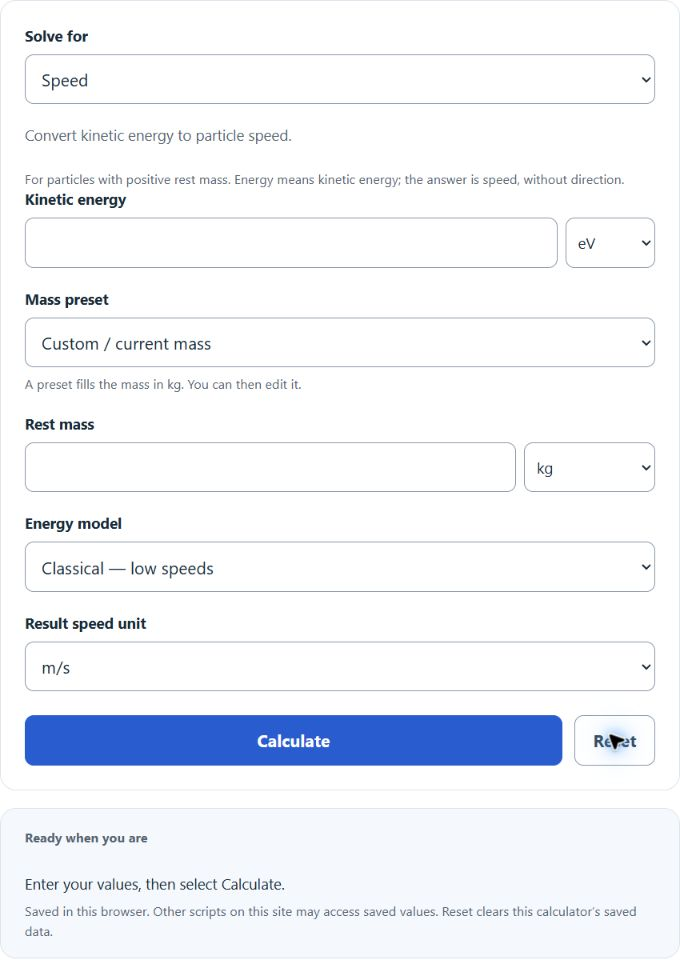
Choose speed, kinetic energy, or rest mass to solve for. Enter the required quantities and select a classical low-speed approximation or relativistic model. Energy is kinetic energy, and all speeds for positive rest mass must be below the speed of light.
eV to Velocity Formula
The following classical equation estimates particle speed when the speed is much less than the speed of light. Use the relativistic model at high speeds: K = (γ − 1)mc², where γ = 1/√(1 − v²/c²) and c = 299,792,458 m/s.
- Where V is the velocity (m/s)
- eV is the number of electron volts (eV)
- m is the mass (kg)
For the classical approximation, convert kinetic energy in eV to joules using 1 eV = 1.602176634 × 10⁻¹⁹ J exactly, divide twice that energy by the positive rest mass in kg, and take the square root. This is speed, not a velocity vector. The relativistic model is needed as speed approaches c.
| Energy | Velocity (m/s) |
|---|---|
| 1 eV | 593100 |
| 2 eV | 838770 |
| 5 eV | 1326210 |
| 10 eV | 1875550 |
| 20 eV | 2652420 |
| 30 eV | 3248540 |
| 50 eV | 4193850 |
| 75 eV | 5136400 |
| 100 eV | 5931000 |
| 150 eV | 7263960 |
| 200 eV | 8387700 |
| 300 eV | 10272790 |
| 500 eV | 13262120 |
| 750 eV | 16242710 |
| 1 keV | 18755470 |
| 2 keV | 26524240 |
| 5 keV | 41938500 |
| 10 keV | 59310000 |
| 15 keV | 72639620 |
| 20 keV | 83877010 |
| Computed using KE = ½ m v² with e = 1.602176634×10^-19 J/eV and m = m_e. Non‑relativistic approximation; accuracy decreases as v approaches c. | |
How to Calculate Velocity from eV?
Example Problem:
The following example outlines the steps and information needed to calculate velocity from eV.
First, determine the number of electron volts. In this example, the number of electron volts is found to be 30 eV.
Next, determine the mass. For this problem, the mass is found to be .0000035 kg.
Finally, calculate the velocity from eV using the formula above:
V = SQRT(2* eV * 1.602176634*10^-19 / m)
V = SQRT(2* 30 * 1.602176634*10^-19 / .0000035)
V ≈ 0.00000165728 m/s (classical approximation)