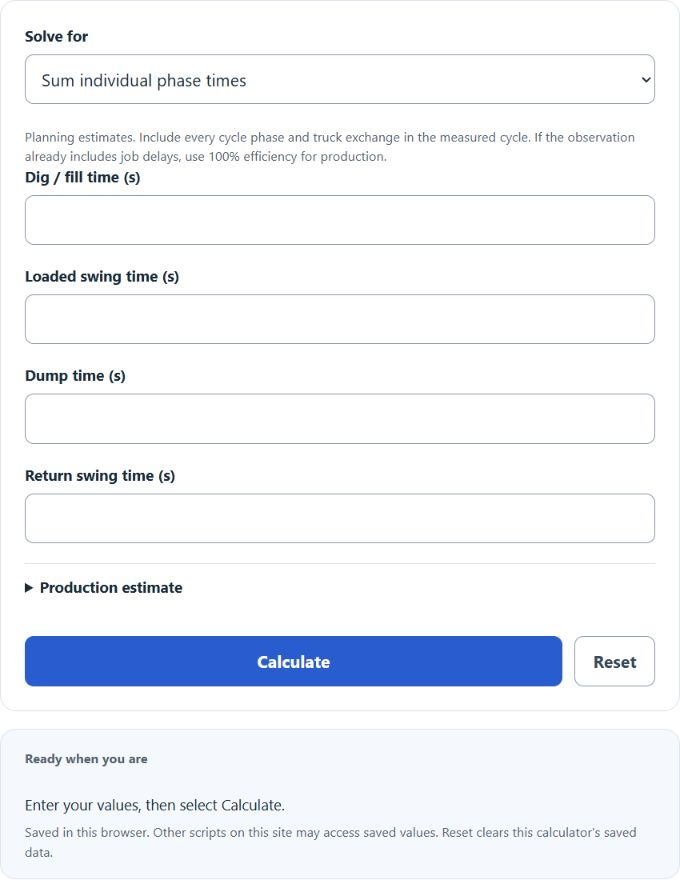
Calculate excavator cycle time from phase timings or a field sample, then estimate cycles per hour, loose and bank production, and shift volume.
- All Construction Calculators
- Cycle Time Calculator
- Excavator Productivity Calculator
- Loader Bucket Capacity Calculator
Excavator Cycle Time Formula
The following two example problems outline the steps and information needed to calculate the Excavator Cycle Time.
Variables:
- ECT is the average excavator cycle time (min/cycle when T is in minutes). The calculator leads with seconds/cycle and also shows minutes/cycle.
- T is the total time of operation (min)
- C is the number of cycles
To calculate the excavator cycle time, divide the total time of operation by the number of buckets/cycles.
How to Calculate Excavator Cycle Time?
The following steps outline how to calculate the Excavator Cycle Time.
- First, determine the total time of operation (min).
- Next, determine the number of cycles.
- Next, gather the formula from above: ECT = T / C.
- Finally, calculate the Excavator Cycle Time.
- After inserting the variables and calculating the result, check your answer with the calculator above.
Example Problem :
Use the following variables as an example problem to test your knowledge.
total time of operation (min) = 500
number of cycles = 30
ECT = T / C = 500 / 30 ≈ 16.666667 min/cycle = 1,000 s/cycle. Production estimates require bucket capacity and appropriate fill, efficiency, swell and scheduled shift assumptions.