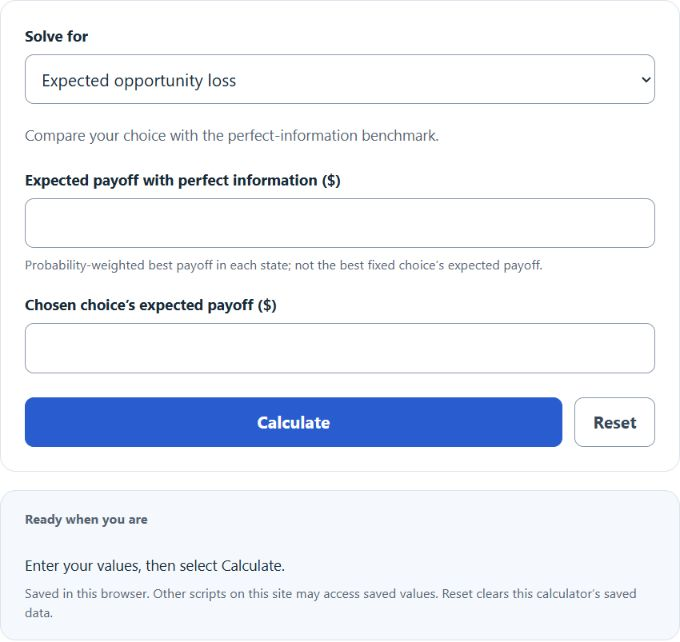
Calculate expected opportunity loss by subtracting your chosen expected payoff from the expected payoff with perfect information. A separate task compares the chosen payoff with the best fixed choice.
Related Calculators
- Compound Probability Calculator
- Sample Proportion Calculator
- Success Ratio Calculator
- Spinner Probability Calculator
- All Statistics Calculators
Expected Opportunity Loss Formula
The following equation computes expected opportunity loss from two averages: the expected payoff with perfect information minus the chosen choice’s expected payoff. Perfect information permits choosing the best action separately in each state.
- Where EOL is the expected opportunity loss ($)
- OP is the expected payoff with perfect information ($)
- AP is the chosen option’s expected payoff amount ($)
To calculate expected opportunity loss, subtract the chosen choice’s expected payoff from the expected payoff with perfect information. Equivalently, weight each state’s regret by its probability and sum. The gap to the best fixed choice’s expected payoff is a different quantity.
What is an Expected Opportunity Loss?
Definition:
Expected opportunity loss (expected regret) is the probability-weighted difference between the best payoff in each state and the payoff of the fixed choice you make. It need not be zero for the choice with the highest expected payoff.
For example, suppose you are choosing between two alternatives. Option A has a 10% chance of a $5,000 payoff and a 90% chance of a $0 payoff. Option B has a guaranteed payoff of $1,200.
First, calculate the expected payoff for Option A:
Expected payoff (A) = (0.10 × $5,000) + (0.90 × $0) = $500
Expected payoff (B) = $1,200
With perfect information, choose A in the 10% state and B in the 90% state: expected payoff = 0.10 × $5,000 + 0.90 × $1,200 = $1,580. Thus EOL(A) = $1,580 − $500 = $1,080, and EOL(B) = $1,580 − $1,200 = $380. The $700 gap between A and B’s expected payoffs is distinct. B minimizes expected regret, and the $380 minimum is the expected value of perfect information.
You should not expect to realize exactly this amount in any single outcome; it is an average based on the stated probabilities and is used for comparing choices under uncertainty.