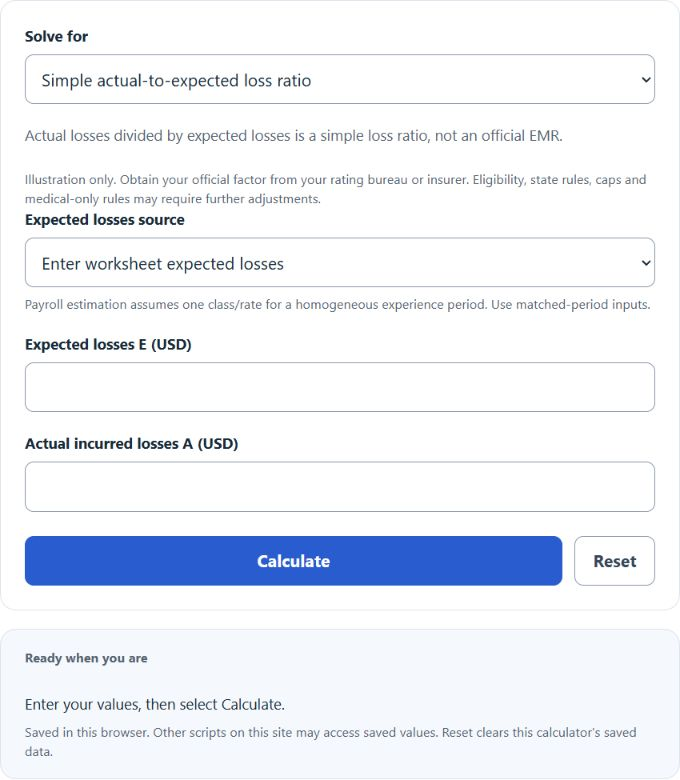
Explore a worksheet-style experience modification factor, loss budgets and premium comparisons. Use current bureau worksheet parameters and the matching experience period. The simple actual-to-expected loss ratio is a separate diagnostic, not an official EMR.
Related Calculators
- Labor Cost Per Unit Calculator
- Payroll Percentage Calculator
- FTE To Hours Calculator
- Bill Rate Calculator
- All Business Calculators
EMR Rate Formula
This educational worksheet formula includes primary losses, weighted excess losses and a stabilizing amount. Obtain the official modification factor from the responsible rating bureau or insurer.
- M is the worksheet-style factor; Ap and Ae are adjusted actual primary and excess losses. The stabilizer S = (1 − W) × Ee + B.
- E is expected losses; Ee = E minus expected primary losses. Expected primary losses may be entered directly or calculated using the matching D-ratio.
- W is the weighting factor and B is ballast, from the applicable worksheet.
For one class and period, expected losses = payroll / 100 × expected loss rate. Multiple classes or periods require matching rates and summed worksheet losses. Split each limited claim separately; a total loss amount and claim count cannot determine primary losses. Apply any medical-only adjustment after splitting. Eligibility, caps and state-specific rules can change the official result.
How to Calculate EMR Rate?
These examples use illustrative parameters, not current rating values. Dollar amounts are USD.
Example Problem #1:
- Use expected losses E = $100,000 and expected primary losses = $30,000, so Ee = $70,000.
- Enter adjusted actual primary losses Ap = $25,000, excess losses Ae = $40,000, W = 0.25 and ballast B = $20,000.
- Calculate the stabilizer: (1 − 0.25) × $70,000 + $20,000 = $72,500.
M = ($25,000 + 0.25 × $40,000 + $72,500) / ($100,000 + $20,000)
The numerator is $107,500 and the denominator is $120,000.
M ≈ 0.895833. This is the unrounded worksheet estimate; bureau rounding and other rules are not applied.
Example Problem #2:
For a separate simple loss-ratio example, use:
Actual losses = $60,000
Expected losses = $75,000
Actual / expected = $60,000 / $75,000 = 0.8. This ratio alone is not an official modification factor.
Premium comparison = premium subject to the modification × factor. It excludes other charges and does not guarantee a policy price or bid eligibility.