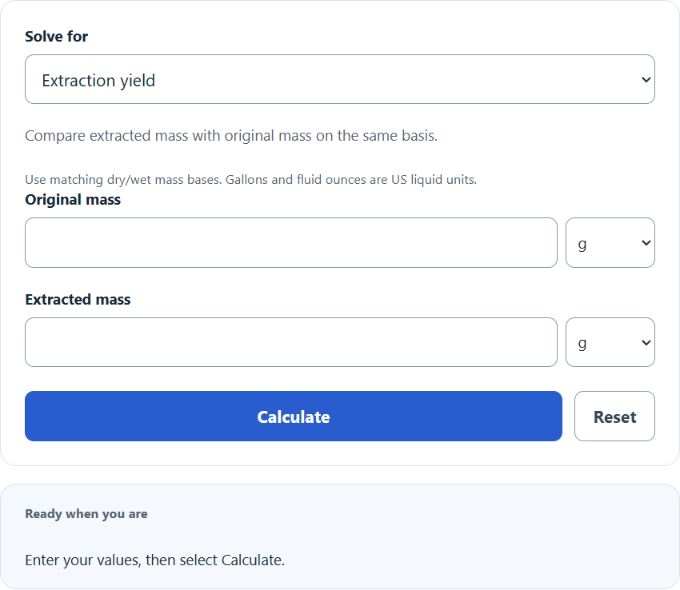
Calculate extraction yield, original weight, extracted weight, and solvent-to-feed ratio with unit conversions for weight and volume.
Related Calculators
- Partition Coefficient Calculator
- Mass Balance Calculator
- Molarity Calculator
- Chemistry Volume Calculator
- All Chemistry Calculators
Extraction Yield Formula
Variables:
- EY is the Extraction Yield (%)
- EW is the extracted weight (g)
- OW is the original weight (g)
To calculate Extraction Yield, divide the total extracted weight by the original material weight, then multiply by 100.
How to Calculate Extraction Yield?
The following steps outline how to calculate the Extraction Yield.
- First, determine the extracted weight (g).
- Next, determine the original weight (g).
- Next, gather the formula from above = EY = EW / OW * 100.
- Finally, calculate the Extraction Yield.
- After inserting the variables and calculating the result, check your answer with the calculator above.
Example Problem :
Use the following variables as an example problem to test your knowledge.
extracted weight (g) = 90
original weight (g) = 100
Extraction Yield = 90 / 100 × 100 = 90%.
FAQs
What is Extraction Yield?
Extraction Yield refers to the percentage of material extracted from the original substance. It is calculated by dividing the weight of the extracted material by the original weight of the material, then multiplying by 100 to get a percentage.
Why is knowing the Extraction Yield important?
Understanding the Extraction Yield is crucial for efficiency and cost-effectiveness in manufacturing and processing industries. It helps in assessing the performance of extraction processes and in optimizing resource use.
Can the Extraction Yield formula be used for any material?
The mass-ratio formula applies when original and extracted masses use a comparable basis, such as both dry masses. Residual solvent, moisture or added material can inflate apparent yield; this is not a measure of extract purity.
How can I improve my Extraction Yield?
Improving Extraction Yield may involve optimizing the extraction process, which could include adjusting temperatures, pressures, or using different solvents or techniques. It’s also important to ensure accurate measurements and minimize losses during processing.