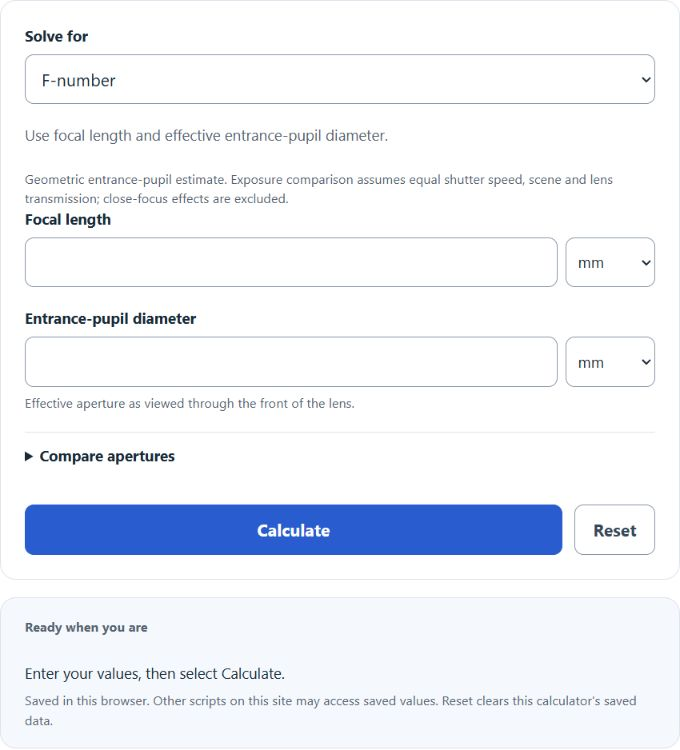
Calculate f-number, aperture diameter, or focal length with real unit conversion, aperture area, nearest full stop, and exposure-light comparison.
- Every Day Life And Education Calculators
- Hyperfocal Distance Calculator
- Field of View Calculator
- Angle of View Calculator
- Magnification Calculator
- Exposure Value Calculator
F-Stop Formula
The following formula is used to calculate an f-stop (f-number).
- Where N is the f-stop (f-number)
- f is the focal length
- D is the entrance pupil diameter (often approximated as the aperture diameter)
To calculate an f-stop, divide the focal length by the entrance pupil (aperture) diameter.
F-Stop Definition
What is an f-stop? An f-stop (f-number) is the ratio of a lens’s focal length to the diameter of its entrance pupil (often approximated as the aperture diameter). It is usually displayed on a camera or lens when you change the aperture setting.
Example Problem
How to calculate F-stop?
- First, determine the focal length.
For this example, the focal length of the camera is 10 mm.
- Next, determine the aperture diameter.
For this problem, the aperture (entrance pupil) diameter is found to be 5 mm.
- Finally, calculate the f-stop.
Using the formula above, the f-stop can be calculated. N = f/D = 10/5 = 2.
About F-Stop
What does f-stop affect? Different f-stops affect exposure (how much light reaches the sensor/film) and depth of field; very small apertures (high f-numbers) can also reduce sharpness due to diffraction.
Is f-stop the same as shutter speed? An f-stop and shutter speed are not the same. F-stop refers to the ratio of focal length to entrance pupil (aperture) diameter, while shutter speed is a measure of how long the shutter is open (typically in seconds or fractions of a second).