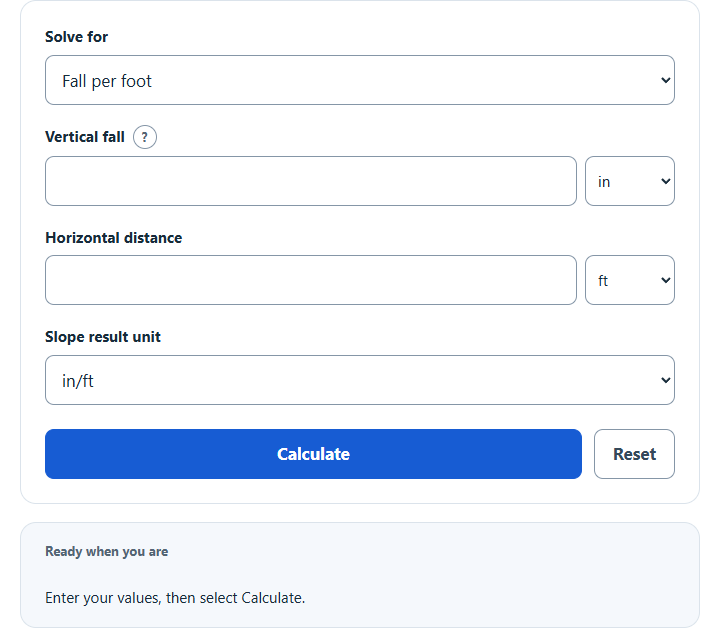
Calculate fall per foot from total drop and run in inches per foot or percent, or find the total fall over a distance or the run for a given slope.
Related Calculators
- Ceiling Slope Calculator
- Length of Slope Calculator
- Common Rafter Length Calculator
- Drip Edge Calculator
- All Construction Calculators
Calculator Functions
| Function | What it does | What it requires |
|---|---|---|
| Fall per foot | Finds the slope as fall per unit of horizontal distance | Requires the vertical fall and the horizontal distance |
| Total vertical fall | Finds the total drop over a run at a known slope | Requires the fall per unit distance and the horizontal distance |
| Horizontal distance | Finds the run needed to drop a set amount at a known slope | Requires the vertical fall and the fall per unit distance |
Fall and distance can be entered in inches, feet, centimetres or metres, and each can use a different unit. The slope can be entered or shown in inches per foot, feet per foot, percent, or any same-unit ratio such as cm per cm. A negative fall means the surface rises.
Fall Per Foot Formulas
| F | Fall per foot |
| T | Total vertical fall |
| D | Horizontal distance |
With T in inches and D in feet, F comes out in inches per foot. With both in feet it is feet per foot, and multiplying that by 100 gives the percent slope. One inch per foot is 1/12 ft/ft, or 8.333%. A 1% slope is 0.12 inches per foot, close to 1/8 inch, and a 2% slope is 0.24 inches per foot, close to 1/4 inch.
Fall per foot
The main formula applies directly. A patio that drops 3 inches over 12 feet falls 3 ÷ 12 = 0.25 inches per foot. The result also shows it as 0.020833 ft/ft and 2.0833%.
Total vertical fall
A pipe laid at 0.25 inches per foot over a 20 foot run drops 0.25 × 20 = 5 inches from one end to the other.
Horizontal distance
Dropping 6 inches at 0.25 inches per foot takes 6 ÷ 0.25 = 24 feet of run. The slope cannot be zero, and the fall and slope need the same sign.
Limits of This Estimate
- The distance is the level, horizontal run, not the length measured along the sloping surface. On gentle slopes the two are nearly equal, and the gap grows as the slope steepens.
- The result is geometry only. It does not say whether a slope meets a plumbing, drainage, roofing or accessibility requirement.
- A single figure describes an even slope from end to end. A surface with dips or a change of grade has a different fall in each section.