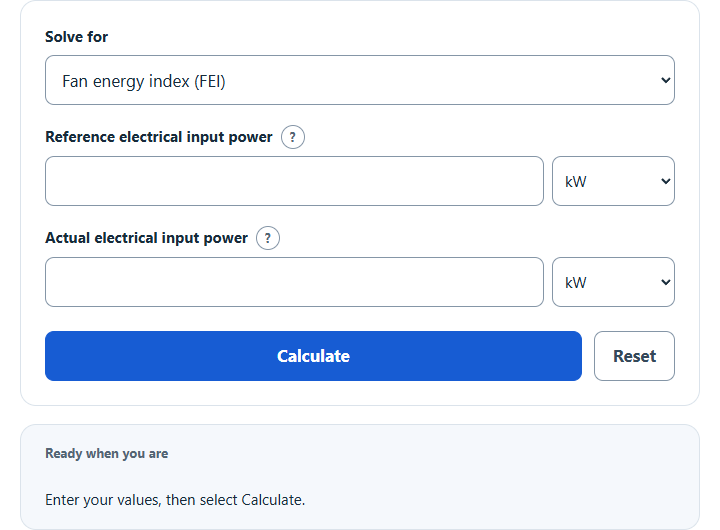
Calculate Fan Energy Index from reference and actual fan electrical input power at the same duty point, or solve for either power.
Calculator Functions
| Function | What it does | What it requires |
|---|---|---|
| Fan energy index (FEI) | Finds the ratio of reference to actual electrical input power | Requires the reference electrical input power and the actual electrical input power |
| Reference electrical input power | Finds the reference power that goes with a given FEI | Requires the actual electrical input power and the FEI |
| Actual electrical input power | Finds the actual power a fan may draw at a given FEI | Requires the reference electrical input power and the FEI |
Power is accepted in kW, W or hp, with 1 hp taken as 745.7 W, and power results are shown in kW. Every result also lists actual power as a percentage of the reference and how far the fan sits above or below it.
Fan Energy Index Formulas
| FEI | Fan energy index (no units) |
| Pref | Reference (baseline) fan electrical input power at the duty point |
| Pact | Actual fan electrical input power at the same duty point |
Both powers are electrical input at the same airflow and pressure. FEI is a wire-to-air measure, so the actual power includes the losses in the motor, the belt or other transmission and any speed controller, not just the fan shaft power [1]. The reference power is what a baseline fan and drive would draw at that duty point. It is calculated separately from the airflow and pressure, and this calculator takes it as an input instead of deriving it.
An FEI above 1 means the fan draws less electrical power than the reference, and below 1 means it draws more. FEI is inversely proportional to fan power, so a fan with an FEI of 1.25 uses 20% less power than the reference [1].
Fan energy index (FEI)
With a reference power of 8 kW and an actual input of 10 kW, FEI = 8 ÷ 10 = 0.80. The fan draws 125% of the reference power, which is 25% above it.
Reference electrical input power
A fan drawing 10 kW with an FEI of 1.2 implies a reference power of 1.2 × 10 = 12 kW.
Actual electrical input power
To reach an FEI of 1.2 against a 12 kW reference, the fan and its drive can draw at most 12 ÷ 1.2 = 10 kW. This is the form to use when a code or rebate program sets a minimum FEI.
Limits of This Estimate
- The result is only as good as the reference power entered. A ratio of two arbitrary powers is not a certified FEI and does not show compliance with a code or regulation.
- Both powers must be for the same airflow, the same pressure basis (total or static) and the same air density. FEI changes from one duty point to another on the same fan.
- Motor nameplate horsepower and shaft power are not electrical input power. The hp unit here is only a conversion of electrical watts at 745.7 W per hp.
Sources
- Air Movement and Control Association International, Introducing the Fan Energy Index, white paper, October 2016: the FEI definition as baseline over actual electrical input power, what the powers include and how FEI relates to power